
Insights
2,000 Force-Controlled Arms: Robot Joint Sourcing in 2026
INDUSTRY NEWS · ROBOTICS & PRECISION COMPONENTS · SEPTEMBER 2026
A 2,000-unit order for force-controlled arms, a dexterous hand playing piano in real time, and a joint-motor joint venture crossing from defence into humanoids. The robot story this week is not about intelligence. It is about parts.
On 23 September 2026, China Robot Network (robot-china.com) reported that an order for 2,000 humanoid force-controlled arms had been finalised, described as accelerating industrial embodied-intelligence deployment. On 24 September 2026, the same outlet reported that Jingshi Technology’s VIVA dexterous hand performed a real-time four-hand piano duet with a human, together with a music-oriented embodied model, as a stage milestone; that RMCS had opened a joint laboratory to connect defence and humanoid joint motor technology; and its own analysis piece framed the humanoid robot “fingertip” problem as both a technical contest and a volume-production test.
Read together, these items describe where the money and the difficulty now sit. The controller, the model and the demonstration are converging fastest; the actuator, the joint and the fingertip are where yield, consistency and spares determine whether a product can actually ship at scale.
Four components that decide whether a robot programme delivers
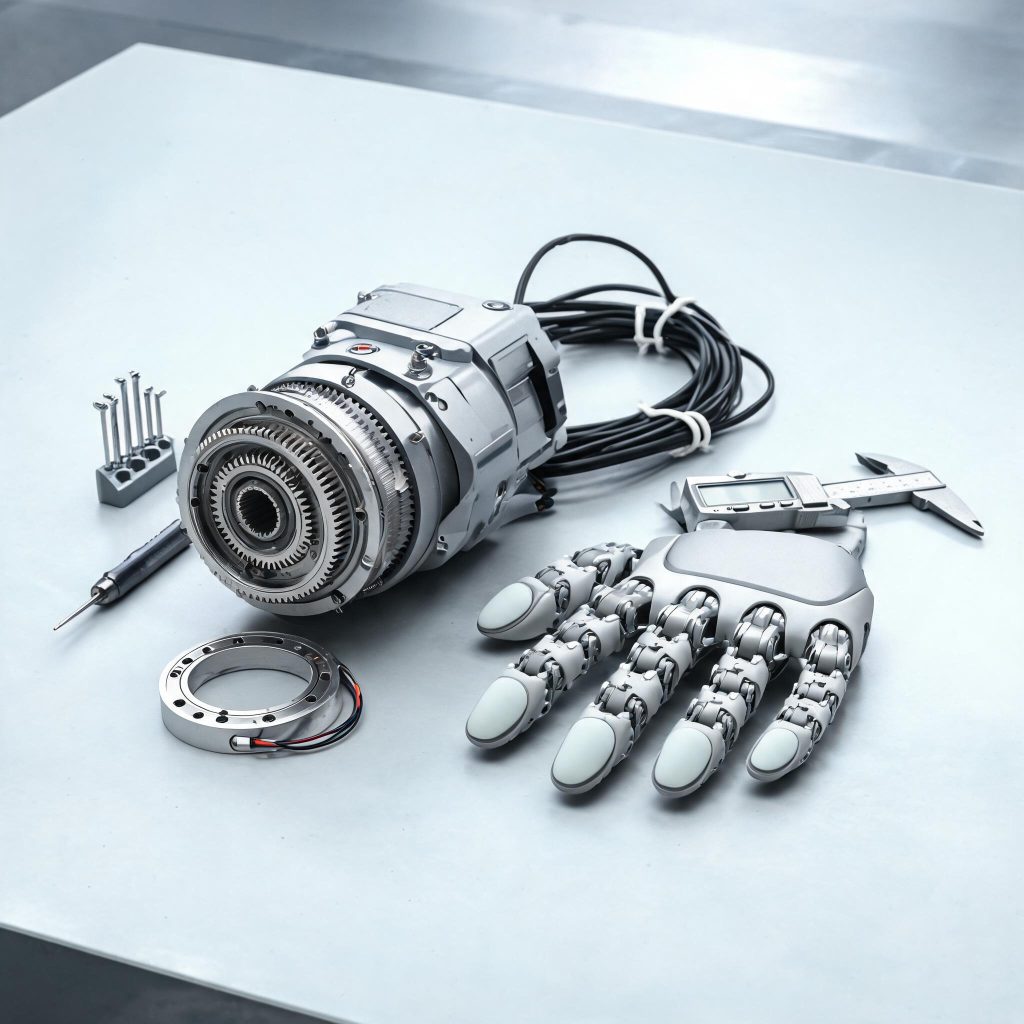
- Joint modules and harmonic drives. A 2,000-unit arm order translates into thousands of reduction gears, torque sensors and motors. Each has its own tooling and its own yield curve, and the tooling has to be built before the first shipment, not after.
- Torque sensing. Force-controlled arms are only force-controlled if the force measurement is repeatable. Sensor calibration drift is the failure mode that shows up months after installation, so lifetime and drift data matter more than initial accuracy.
- Dexterous hands. Real-time coordination — a hand reacting to a human player rather than replaying a script — is a control-bandwidth and latency claim. Those same properties constrain how many fingers can be actuated and how much tactile sensing fits in the finger.
- Tactile and vision sensing in the fingertip. The same reporting that covers the fingertip contest also shows a competing optical route into tactile sensing. Finger-mounted sensing is now a genuine multi-technology decision, not a default.
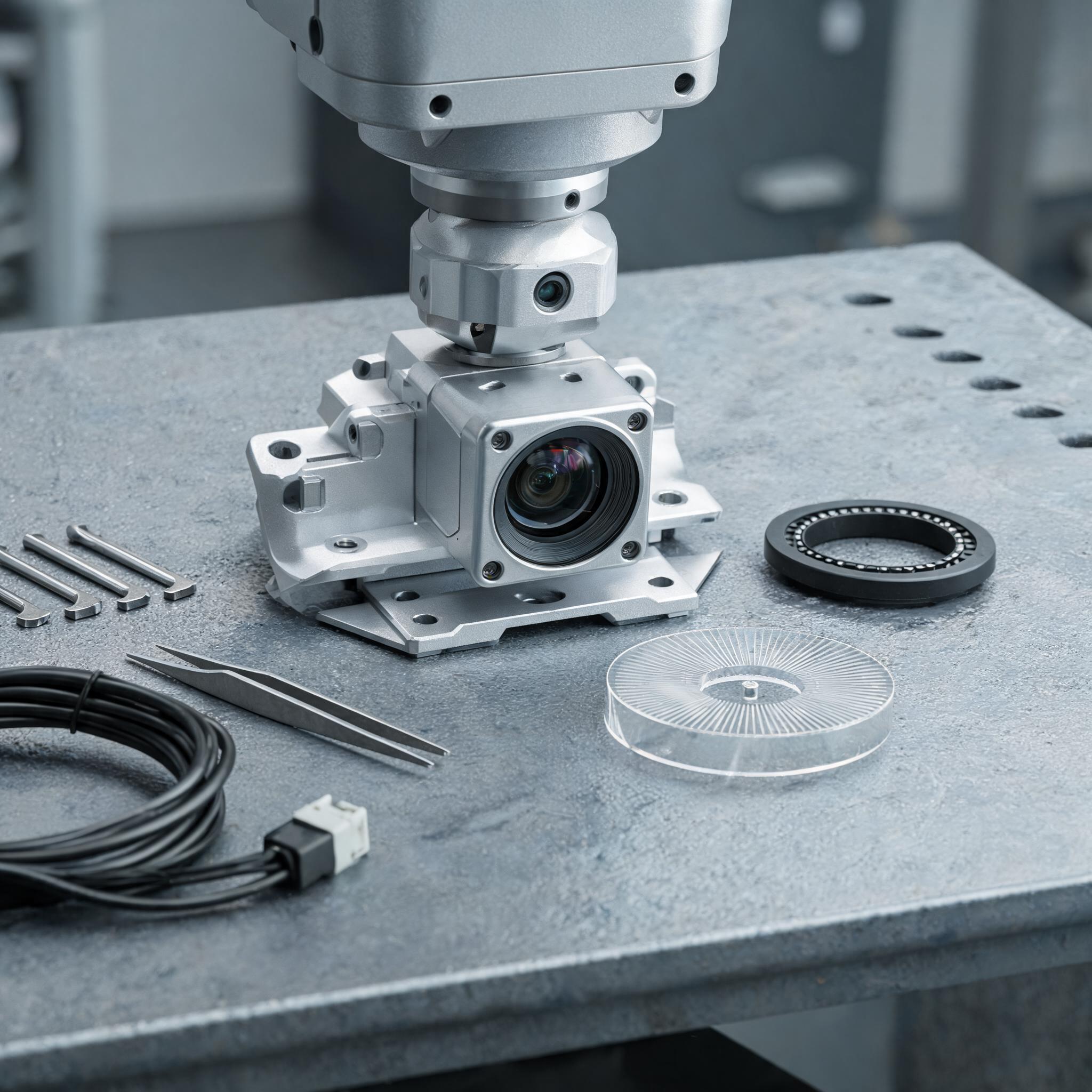
- Optical components are already in the robot bill of materials. Cameras, lens assemblies, optical encoders, LiDAR windows and machine-vision optics all sit inside a robot, and several of them demand the same as-pheric, coated, athermalised parts that our optical lines produce. Robot programmes are therefore an adjacency for optical suppliers, not a separate industry.
Explore Camera & Robot Sourcing →
How to qualify a robot component supplier
- Ask for the production data, not the demonstration video. Cycle counts, repeatability over temperature and mean time between failures tell you how a part behaves after the camera stops rolling.
- Quote the spare part alongside the assembly. A joint module is a wear item. If the spare is not priced and available at the same time as the unit, the maintenance plan is incomplete.
- Confirm tooling ownership and mothballing terms. For robot programmes that ramp in steps, know who owns the tooling and what happens to it if volumes pause for a quarter.
- Dual-source the wear items, single-source nothing else. Reduction gears, sensors and fingertip pads are where cost and risk concentrate. A qualified second source on those parts is worth more than a second source on the frame.
- Test at the module level, not the component level. A joint that passes individually can still fail when assembled, because thermal paths, cable routing and calibration all change. Insist on module-level acceptance criteria.
Sourcing robot components, machine-vision optics or custom assemblies?
Send your drawings, quantities, target unit cost and required schedule to sales@tuolango.com and we will return a sourcing comparison with qualified options.
Sources and disclosure
Sources: China Robot Network (robot-china.com) reports of 23 September 2026 on a 2,000-unit humanoid force-controlled arm order, and of 24 September 2026 on Jingshi Technology’s VIVA dexterous hand real-time four-hand performance with a music-oriented embodied model, on the RMCS joint laboratory connecting defence and humanoid joint-motor technology, and on the humanoid robot fingertip technology and volume-production contest. Supplier-qualification guidance is TUOLAN TRADE analysis. Edited and analysed by TUOLAN TRADE.