
Insights
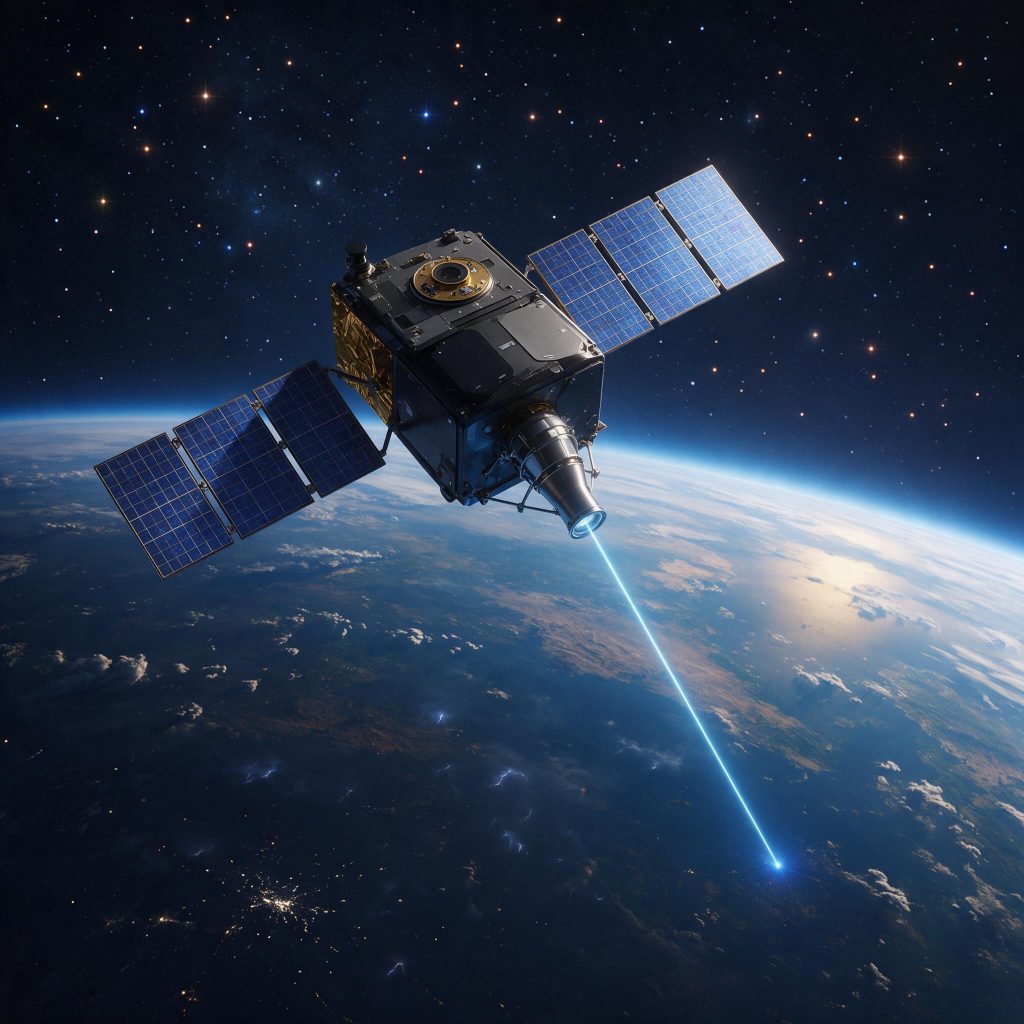
100 Gbps Space Laser Terminal Reaches Orbit: What It Survives
INDUSTRY NEWS · SPACE OPTICS · SEPTEMBER 2026
A 100 Gbps laser communication terminal developed entirely in-house by Changchun University of Science and Technology reached orbit aboard the Pengcheng-1 satellite on 20 September. The payload has completed its unlock sequence and reported good self-check results. For optics suppliers, the interesting part is not the bit rate — it is the list of things that had to survive launch and keep working in vacuum.
China launched the Pengcheng-1 (Nanshan-1) satellite on 20 September aboard a Lijian-1 Y18 rocket from the Dongfeng commercial space launch site. On board was a 100 Gbps high-speed laser communication payload, developed entirely by the Space Optoelectronic Technology Institute at Changchun University of Science and Technology. The university reports the payload has completed its unlock action and that self-check status is good, with mechanism rotation, multi-mode communication, optical-mechanical coaxiality and camera imaging quality all meeting expectations.
The programme will run a series of in-orbit experiments with the Pengcheng National Laboratory, focused on 100 Gbps satellite-to-ground laser data transmission and adaptive wavelength adjustment.
What the team says it had to solve
The university lists four core technology areas the team had to break through: high-precision optical acquisition and tracking, precision opto-mechanical structure design, lightweight integrated design and space thermal stability control. The engineering difficulties it calls out are equally specific: on-board micro-vibration, high-speed relative motion and thermal shock cycling in the space environment. The payload was validated through repeated simulation iterations, full-domain ground simulation and extreme-environment reliability testing.
That list is worth reading as a specification outline. Acquisition and tracking set the servo and detector requirements. Coaxiality sets the alignment budget between the transmit and receive paths. Thermal stability sets how much the mount can move across an orbital temperature swing. None of those are decided by the optics alone, but all of them are limited by the optics and the mount.
What space-grade optics programmes have to prove
- Alignment stability under thermal cycling, not at room temperature. A terminal that holds boresight on an optical bench will not hold it across an orbital thermal swing unless the mount and materials are matched. Ask for measured boresight drift over the specified range.
- Resistance to launch vibration and on-orbit micro-vibration. Launch loads and persistent micro-vibration are different failure modes. Both need separate evidence.
- Traceability for every optical element. For space programmes, coating run data, substrate lot and surface quality records are part of acceptance, not optional documentation.
- Cleanliness and outgassing discipline. Vacuum environments punish adhesives, lubricants and elastomers. Material selection has to be declared, not assumed.
- Terminal-level, not element-level, test. The customer is buying a link budget. Prove the assembled terminal, not only its parts.
Optical Coatings & Precision Optics →
Writing the RFQ for a space or airborne optical assembly
- Define the wavelength and the coating by test method. High-reflection and anti-reflection performance should be specified by measured reflectance curve and by environmental test, not by coating name.
- State the alignment budget explicitly. Give the supplier the allowed angular and axial error at the assembly level, and the temperature range over which it must hold.
- Separate the flight unit from the qualification unit. Decide up front how many qualification units the programme needs and what destructive tests are acceptable.
- Declare materials and processes. Substrate, adhesive, coating, cleaning process and packaging all need to be on the drawing.
- Agree on inspection method. Surface quality and scratch-dig are measured differently in the visible and near-infrared. Say which method applies.
Sourcing precision optics and coatings from China?
TUOLAN TRADE helps overseas buyers turn an optical system requirement — wavelength, alignment budget, environmental class — into a manufacturable drawing, compare coating and substrate options on cost and performance, and coordinate sample inspection, test reports and export documentation. Send your specification to sales@tuolango.com.
Sources and disclosure
Figures are compiled from public internet sources dated September 2026: Laser Manufacturing Network (laserfair.com) reporting, citing Changchun University of Science and Technology, on the 20 September launch of the Pengcheng-1 (Nanshan-1) satellite carrying a 100 Gbps laser communication payload developed by the university’s Space Optoelectronic Technology Institute, its completed unlock action and reported self-check status, and planned in-orbit validation of 100 Gbps satellite-to-ground laser transmission and adaptive wavelength adjustment. Performance figures and self-check results are the developing institution’s own published statements and are not independently verified here. Editorial analysis and sourcing guidance in this article are our own assessment. TUOLAN TRADE is not affiliated with any company or institution mentioned; names belong to their respective owners.