
Insights
Dual-Band MWIR/LWIR: 8um Lens Design Rules

INDUSTRY NEWS · INFRARED LENSES · CIOE 2026
Two detector launches at CIOE 2026 — a dual-band MWIR/LWIR cooled engine and an 8μm megapixel uncooled micro engine — quietly rewrite the specification rules for infrared lenses. Here is what changes for buyers and optical designers.
Infrared lenses are designed around the detector behind them — and at CIOE 2026, that detector moved. Guide Infrared presented two engines that directly change what an infrared lens must do: the GAVIN1215MLC dual-band cooled engine, and the iTL1208, described by the exhibitor as the industry’s first 8μm pixel-pitch megapixel uncooled micro engine.
Dual-band from one detector: coatings must cover 3–5μm and 8–12μm
The GAVIN1215MLC covers the mid-wave (MWIR) and long-wave (LWIR) atmospheric windows simultaneously, using a single dual-band focal plane — reported as a Type-II superlattice / MCT device — at 1280×1024 resolution with a 15μm pitch. Synchronized dual-band output simplifies band-to-band registration for detection in smoke, haze and thermal-crossover conditions.
The lens consequence: one optical path now has to transmit and stay corrected across both 3–5μm and 8–12μm. That means dual-band anti-reflection coatings, careful material pairing (germanium, chalcogenide and ZnS behave very differently across the two windows) and focus held across both bands. A lens specified for LWIR alone will not qualify.
The 8μm shift: SWaP drops, MTF budgets tighten
The iTL1208 is described as the industry’s first 8μm pixel-pitch megapixel uncooled micro engine — about 22.6×22.6×34.5 mm and roughly 34.5 g with lens. For the same field of view, smaller pixels shorten focal lengths and shrink the whole optical stack, which is exactly what drone payloads, handhelds and distributed machine-vision nodes want.
The trade-off lands on the lens: at 8μm pitch, diffraction limits and MTF at the pixel Nyquist frequency become the design battleground. Off-the-shelf lenses designed for 12μm or 17μm detectors leave resolution on the table.
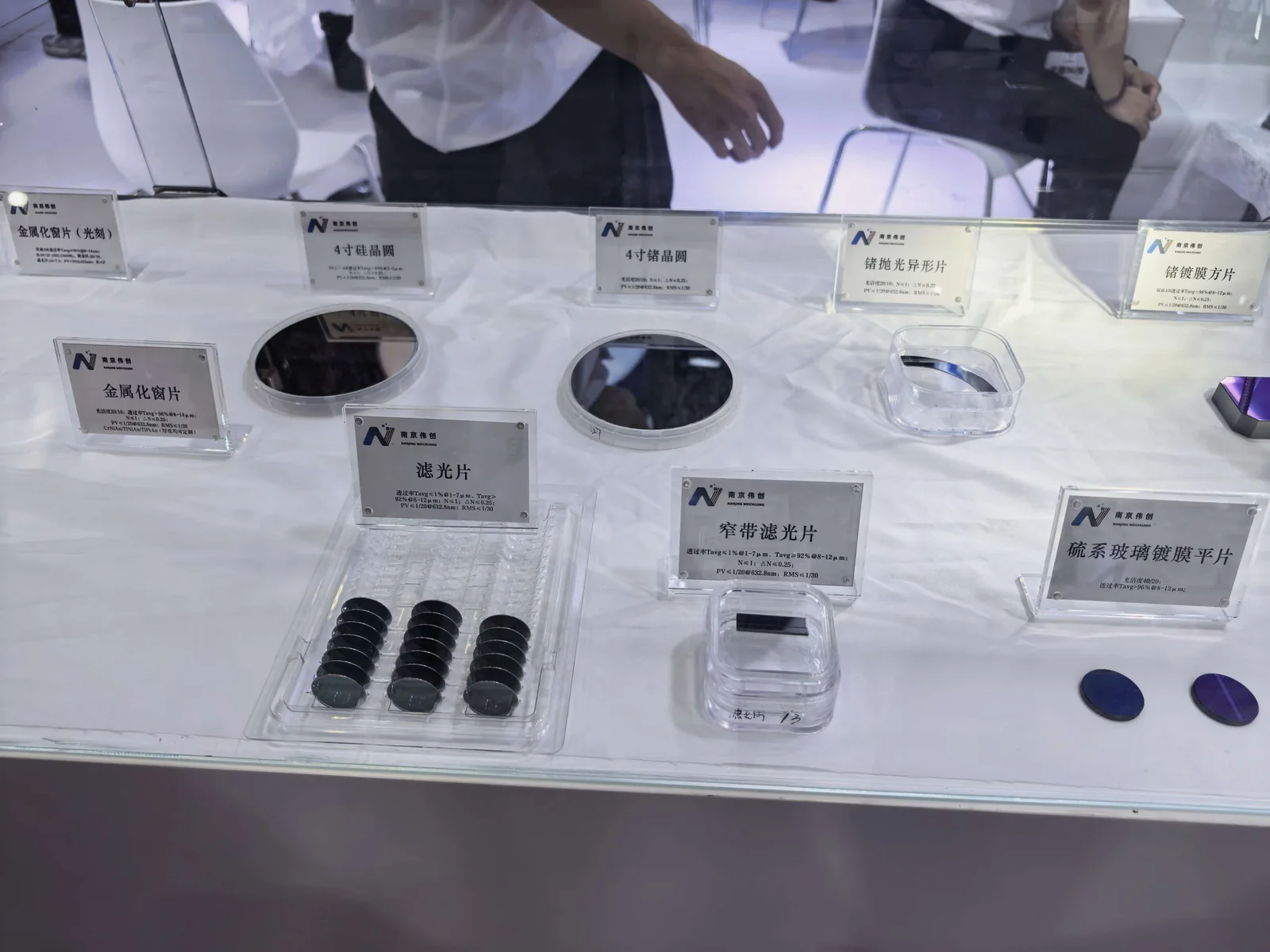
Multi-sensor fusion adds another design axis
Raytron (InfiRay) demonstrated what it calls the world’s first SWIR-plus-thermal dual-spectrum fusion camera at the same show — more evidence that buyers increasingly specify combined visible/SWIR/thermal stacks instead of a single band. Every added band is another coating-material-detector matching exercise.
What to specify in your next infrared lens RFQ
Given where detectors are heading, an RFQ written for 2026-era engines should state five things explicitly:
- Detector format and pixel pitch (e.g., 1280×1024 at 8μm vs 15μm) — this sets the MTF target
- Band plan: single-band, dual-band (MWIR+LWIR), or SWIR+thermal fusion
- Coating transmission requirements across every band in use
- Athermalization range, if the payload is uncooled and outdoor-rated
- Envelope and mass budget (SWaP), including the lens barrel and mount
Need an infrared lens matched to a modern focal plane?
TUOLAN TRADE designs and sources dual-band coated assemblies and SWaP-optimized athermalized lenses for 8–17μm detectors. Send your detector format, band plan and envelope to sales@tuolango.com — factory visits and audits can be arranged.
Sources and disclosure
All information in this article is compiled from public internet sources, including Guide Infrared / Guide Sensmart published materials and Chinese industry coverage of CIOE 2026 (September 9–11, Shenzhen). Photographs are from an independent exhibition visit and do not depict the named exhibitors’ products. TUOLAN TRADE is not affiliated with the companies mentioned; product names belong to their respective owners.