
Insights
Robot Tactile Sensing: Three Routes and the Optical One
INDUSTRY NEWS · ROBOTICS & OPTICS · SEPTEMBER 2026
Robot hands have crossed the point where the industry agrees touch is mandatory and started arguing about how to produce it at volume. Three sensing routes are in play — flexible arrays, magnetic hall arrays and vision-based tactile sensing — and only the third one puts a camera and a lens inside a fingertip. That is the one optics suppliers should be reading.
Force-torque sensors measure what happens at a joint. Fingertip tactile sensors measure what happens at the point of contact — pressure, slip and deformation. That distinction is now the accepted framing in the humanoid supply chain, and in 2026 the sector has settled on the view that without touch there is no useful embodied intelligence. What has not settled is which sensing technology scales.
The three routes now in volume discussion each hold a different position in the market.
The three tactile routes and where each breaks
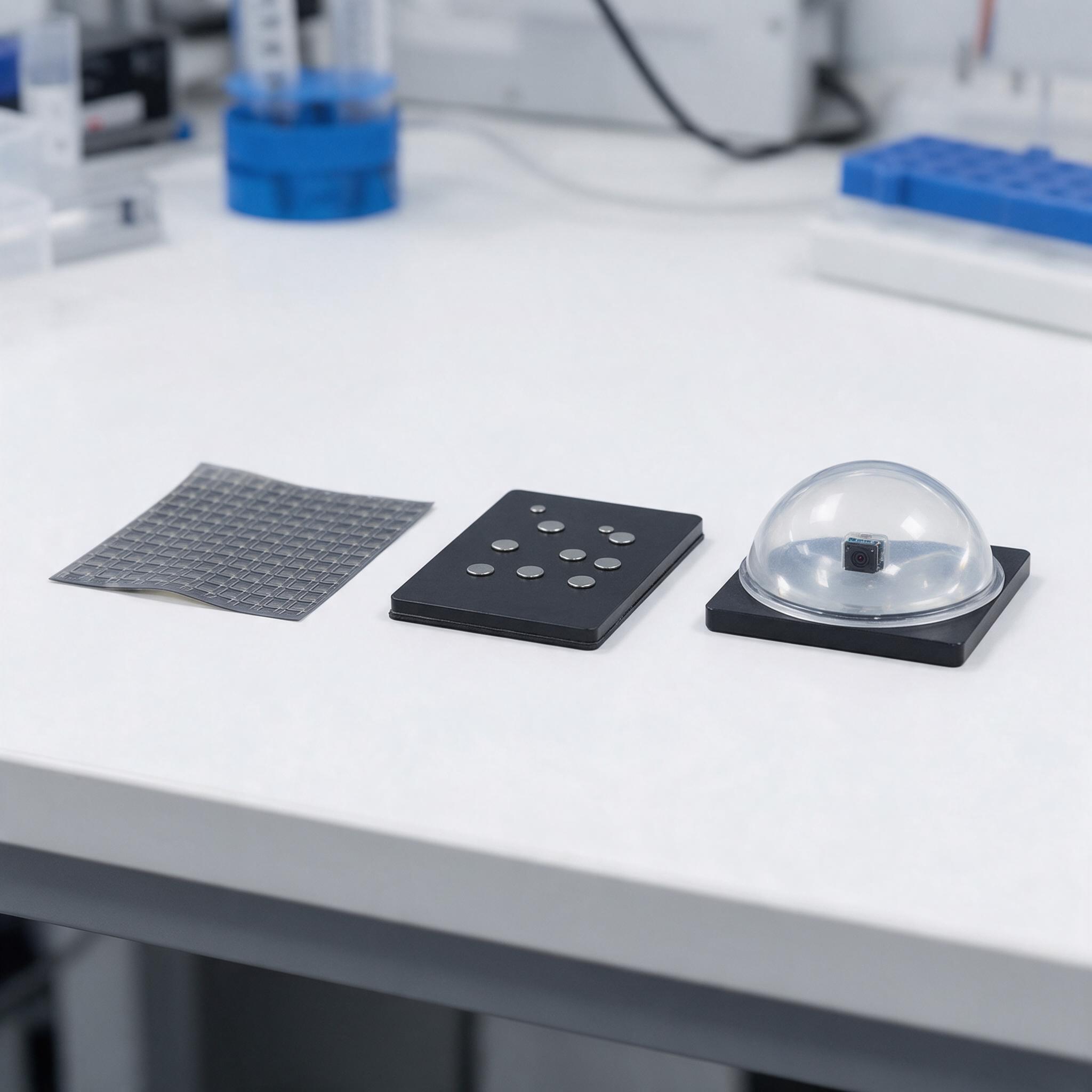
Flexible array tactile sensing (piezoresistive, capacitive, piezoelectric) is the most widely deployed. It works by reading a change in an electrical signal and is already used in products including Xiaomi’s CyberOne humanoid and Dahuan’s dexterous hands. Its advantage is large-area coverage on a mature supply chain. Its limits are equally well documented: piezoresistive designs suffer hysteresis and thermal drift, capacitive designs are sensitive to electromagnetic interference, and piezoelectric designs pick up ambient acoustic noise. All three struggle in high-precision work.
Magnetic hall array tactile sensing is the volume preference for industrial multi-dimensional touch. It resolves force from tiny displacements of a magnet, which gives high stability and cycle reliability and native support for multi-axis force detection. Its constraints are physical: array pitch sets a floor on spatial resolution, so it cannot resolve micro-scale surface texture, and external magnetic fields interfere with it. That rules it out for the most precise assembly tasks.
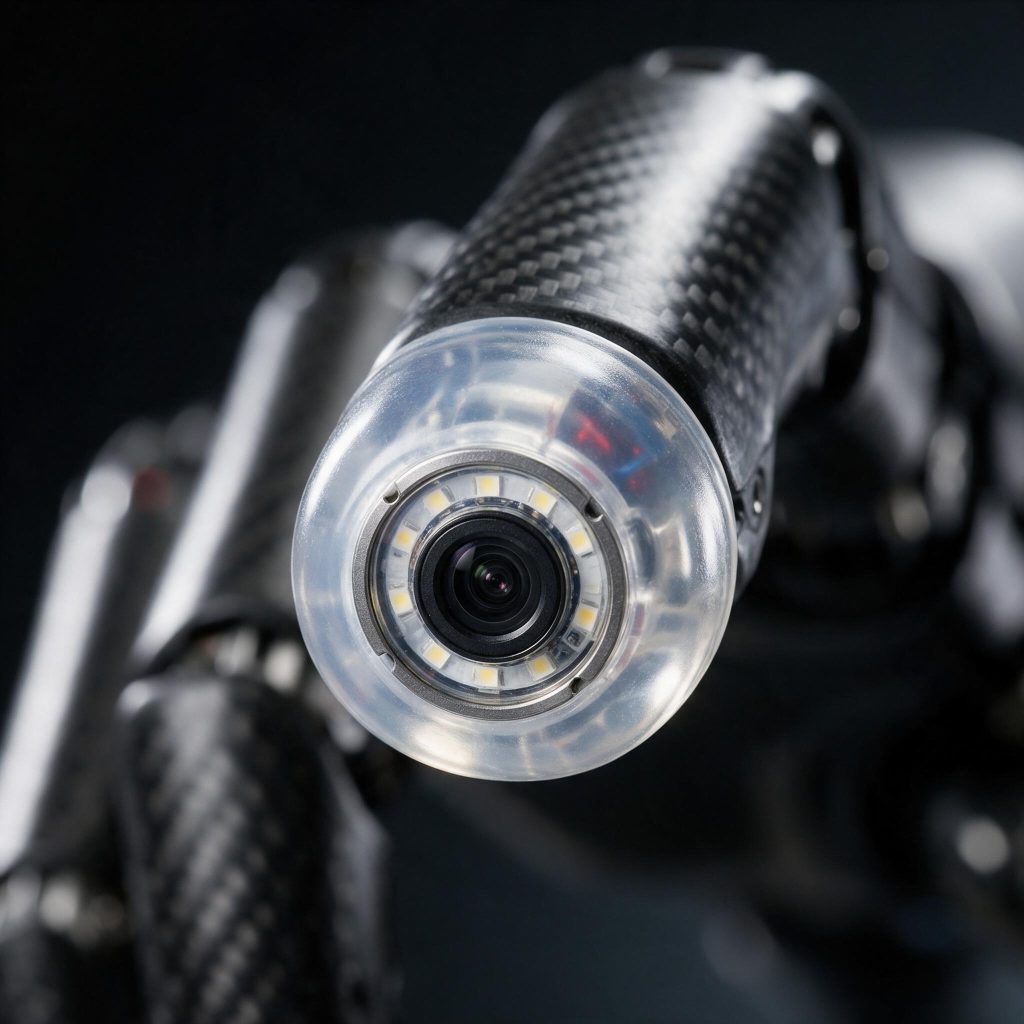
Vision-based (optical) tactile sensing is the route most often described as the end state. A miniature camera and a soft elastomer sit inside the fingertip; the camera watches how the elastomer deforms and infers pressure, slip and surface contour from the image. It replicates how a human hand senses, and it can predict a slip before it happens, because it sees the deformation trend rather than waiting for a force threshold. It is also naturally compatible with the robot’s existing vision stack.
Why this matters for an optics supplier
Read the third route as a bill of materials. A vision-based tactile fingertip needs a miniature lens system, controlled illumination, an image sensor, a transparent or reflective interface between the elastomer and the optics, and a calibration procedure that keeps the mapping from image to force stable over millions of cycles. That is an optical assembly problem with a mechanical durability requirement — not a materials-only problem.
It also mirrors a pattern already seen in consumer devices: the sensing function migrates from a specialty component to an optical module. Suppliers who can build small, aligned, durable optical assemblies for harsh cycle environments are better positioned for this wave than suppliers who only polish lenses.
Camera & Robot Component Sourcing →
Sourcing assessment: how to qualify a tactile sensing supplier
- Ask for cycle life, not sensitivity alone. A tactile fingertip is a wear part. Request contact-cycle test data with the drift curve, not a single sensitivity figure.
- Separate the sensor from the algorithm. A supplier that only sells the sensing element leaves the slip-prediction model to you. Decide who owns the model before you commit to a hardware architecture.
- Verify spatial resolution against your task. Texture recognition, slip prediction and force measurement have different resolution requirements. One sensor will not cover all three.
- Check the optical path for contamination and wear. If there is a camera in the fingertip, the interface surface will be abraded. Ask how the design protects the optical path.
- For magnetic hall designs, plan for field interference. Ask for interference testing near the motors and drivers the hand will actually use.
Sourcing sensing and optical sub-assemblies for robots from China?
TUOLAN TRADE helps overseas buyers specify sensor and optical sub-assemblies for robot programmes, compare sensing routes on cost, resolution and cycle life, and coordinate sample evaluation, test reports and supplier verification. Send your requirement to sales@tuolango.com.
Sources and disclosure
Figures and technical route descriptions are compiled from a public internet source dated September 2026: China Robot Network (robot-china.com) reporting on humanoid robot tactile sensing, describing flexible array tactile sensing (piezoresistive, capacitive, piezoelectric) as the most widely deployed route with use in Xiaomi’s CyberOne and Dahuan dexterous hands, magnetic hall array sensing as the volume choice for industrial multi-dimensional touch, and vision-based optical tactile sensing as the route closest to the human sensing model, alongside the distinction between six-axis force-torque sensors and fingertip tactile sensors. Named products and deployment claims are the original report’s statements and are not independently verified here. Editorial analysis and sourcing guidance in this article are our own assessment. TUOLAN TRADE is not affiliated with any company mentioned; company and product names belong to their respective owners.