
Insights
Corning Expands Polarcor Glass Polarizer Capacity
INDUSTRY NEWS · OPTICAL MATERIALS · SEPTEMBER 2026
Corning is adding capacity for a glass polarizer it first launched in 1984. The reason is not nostalgia. Every coherent link inside an AI data centre has to stop a laser from being disturbed by its own reflection, and that job starts with a wafer of polarizing glass.
Corning Incorporated (NYSE: GLW) announced on 24 September 2026 that it is expanding manufacturing capacity for its Polarcor glass polarizers, pointing to growing demand from AI data centre and computing applications. In the same announcement the company said it has entered a new multi-year supply agreement with what it describes as “a leading active photonics technology company”. The counterparty is not named. Neither the value nor the duration of that agreement has been disclosed, and Corning has not published the size, cost or location of the capacity addition.
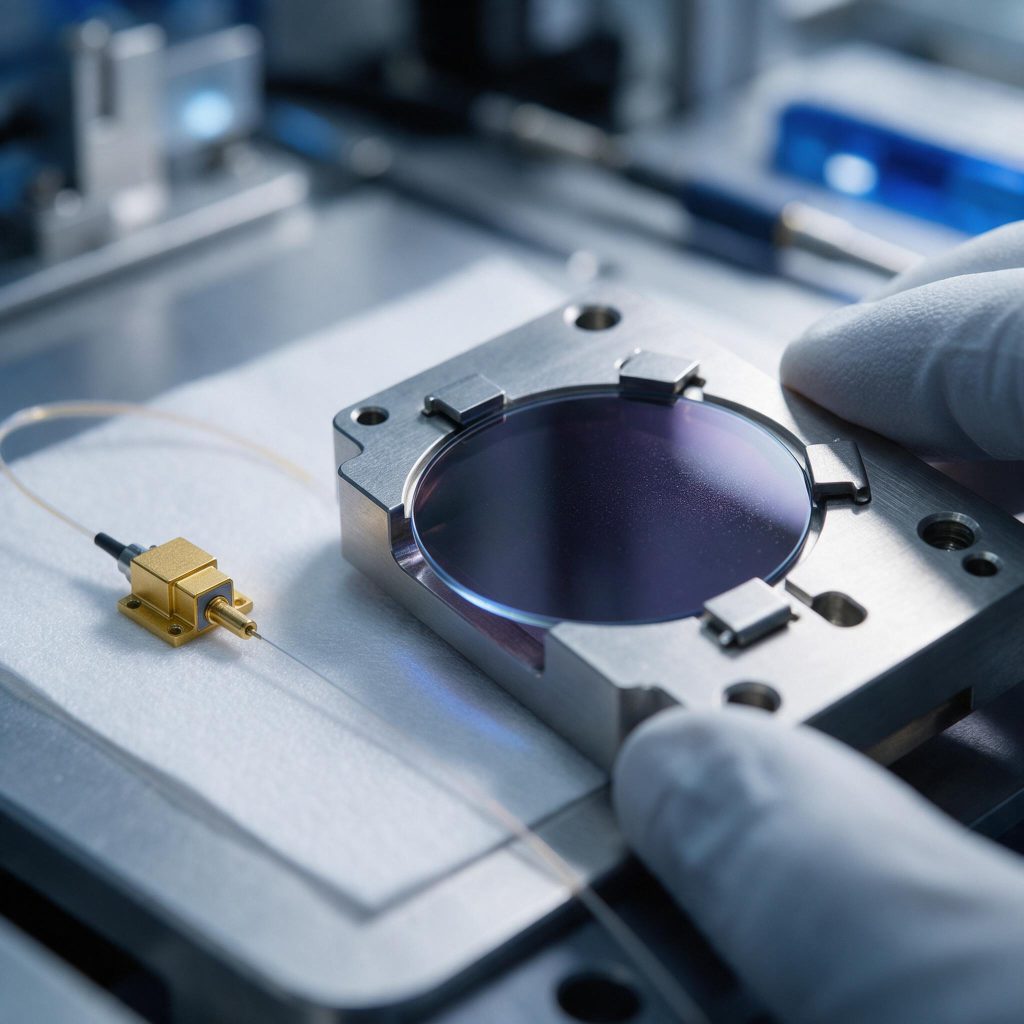
The product is worth understanding before the headline numbers that are not there. Polarcor is an engineered glass polarizer built from a borosilicate glass body in which aligned silver crystals are formed. Polarization comes from resonant absorption inside that crystalline structure rather than from a polymer film laminated between two plates. Corning specifies the technology across a 600 nm to 2,300 nm wavelength range with high extinction and low insertion loss, and offers an UltraThin version just 30 µm thick for polarization management inside communications lasers. The product family dates to 1984, which is unusual longevity for a photonics component.
Why a polarizer matters more as data centre links get denser
A laser diode is a resonant cavity. Any light reflected back into that cavity disturbs the emission, and enough of it will damage the device. An optical isolator is the component that blocks the return path, and the polarizer is the core element inside the isolator. Because the polarizing element here is a monolithic glass wafer rather than an organic film, it tolerates the chemical, physical and thermal environment of a package that sits immediately next to a hot laser.
That is the technical case. The commercial case is the part buyers should read carefully, because the disclosure is deliberately thin and the temptation to fill the gap is high.
- 600 nm to 2,300 nm. The specified range covers the near-infrared wavelengths used by telecom and datacom transceivers and reaches into the 2 µm band used by longer-wavelength sources. A single polarizer platform spanning that range is what lets a supplier serve several laser product families from one glass process.
- High extinction, low insertion loss. Those are the two numbers that decide whether an isolator meets its isolation budget without eating the link margin. Ask for both curves at the operating wavelength, not a datasheet typical.
- A 30 µm ultra-thin option. Thinner polarizing glass exists to solve a packaging problem, not an optical one: it fits inside the small-form-factor packages used for high-speed transceivers where a conventional wafer will not.
- Capacity follows the modulator and the laser, not the network build. Polarizers are consumed inside isolators, and isolators are consumed inside transmitters. The demand signal Corning is responding to is transmitter production, which is why this announcement arrives while 1.6T-class modules are moving into volume rather than after.
- Multi-year agreements are a scheduling instrument. When a component supplier signs a multi-year commitment in a capacity-tight market, the practical effect is that part of the future output is no longer available on spot terms. Buyers without an agreement are the ones who feel the queue.
Explore our Optical Transceivers →
How to specify polarizing optics and isolators
- State the wavelength first, the package second. Extinction ratio and insertion loss are only meaningful at a stated wavelength and temperature. Quote requests that lead with a part number rather than an optical band usually come back ambiguous.
- Ask whether the polarizer is glass or film. Glass polarizers survive higher power and harsher assembly processes. Film polarizers are cheaper and thinner in the laminating sense, but they change the reliability conversation entirely.
- Put isolation and return loss in the same table. The isolator has to protect the laser without adding an unacceptable reflection at its own input face. Both belong on one acceptance sheet.
- Confirm coating durability with the polarizer. Anti-reflection coatings on both faces determine insertion loss. Ask which environmental test the coating has passed, not simply that a coating exists.
- Plan the second source before the ramp, not during it. Capacity announcements are the point in the cycle when lead times loosen for new inquiries and the point when they tighten for uncommitted volume. Getting a second supplier to first-article stage now costs far less than expediting later.
Sourcing polarizers, isolators or coated optics?
Send your wavelength band, extinction and insertion loss targets and annual volume to sales@tuolango.com and we will return a quoted comparison with coating options.
Sources and disclosure
Sources: Corning Incorporated announcement of expanded Polarcor glass polarizer capacity and a new multi-year supply agreement with a leading active photonics technology company, reported by IT Home (ithome.com) on 25 September 2026, People’s Financial News / Securities Times e-company on 24 September 2026 and C114Pro on 24 September 2026; Corning product documentation for Polarcor glass polarizers, including the 600–2300 nm specification range, the 1984 product introduction and the 30 µm UltraThin option. The name of the counterparty, the value and term of the supply agreement, and the scale of the capacity expansion have not been disclosed by Corning or by any of the cited reports, and no market size figures are quoted in this article because no authoritative public figure was located. All figures are reproduced as the cited sources state them and have not been independently audited by us. This article is original editorial analysis by TUOLAN TRADE for industry reference, not investment advice or an offer of securities. Product and company names remain the property of their respective owners.