
Insights
AI Glasses Drop Cameras: Lens and Metalens Sourcing
INDUSTRY NEWS · VISIBLE-LIGHT OPTICS · SEPTEMBER 2026
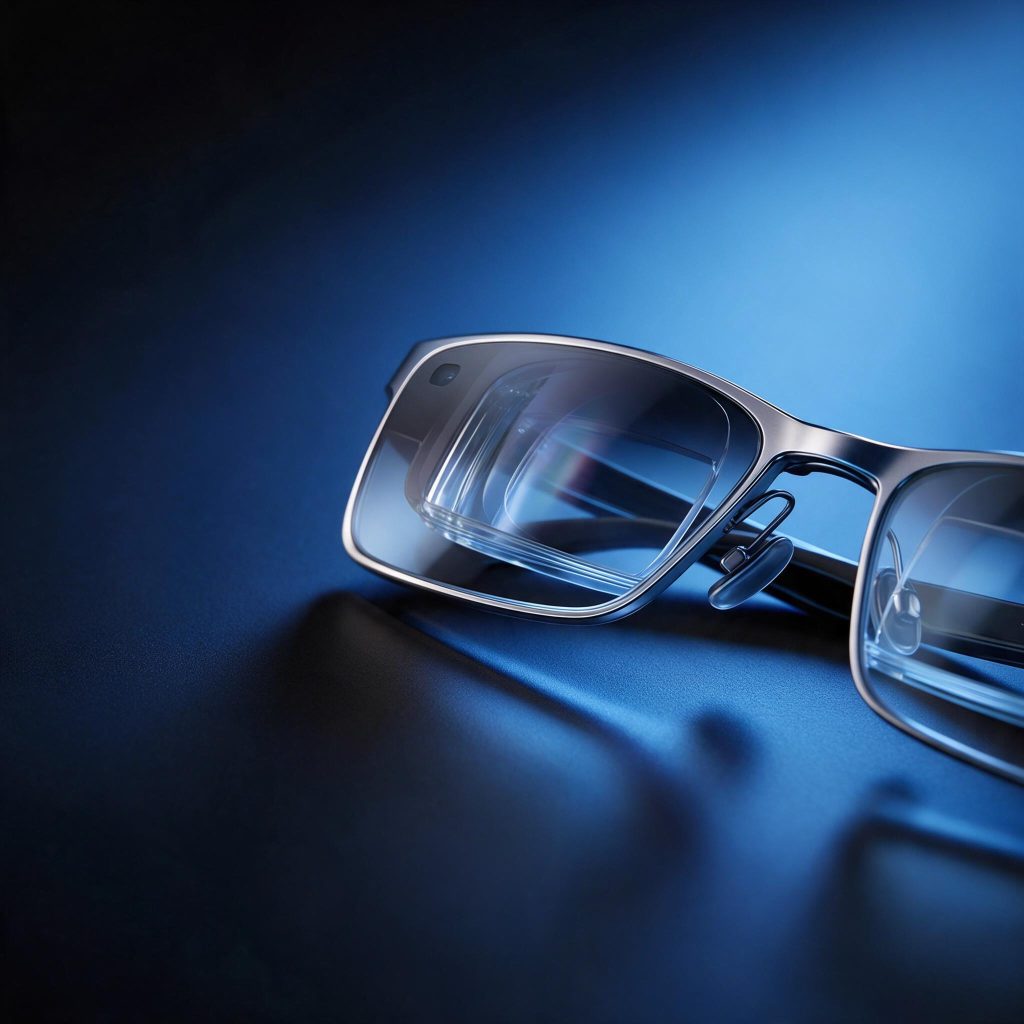
Smart glasses spent three years adding sensors. In September 2026 the direction reversed: cameras are being cut to save weight, power and cost, which pushes the burden onto the lens and display stack. In the same month, metalens moved from laboratory curiosity toward a defined commercial path in eye tracking and depth sensing.
The optics industry usually grows by adding function. This month it grew by removing it. Chinese industry analysis published on 22 September traced the reversal in smart glasses: after several generations of sensor stacking, designers are cutting camera configurations to protect weight, battery life and bill-of-materials cost — a trade-off pattern the same analysis identified in the newest generation of flagship smartphones, where a folding form factor cost the product its standalone telephoto module. When a camera is removed, the remaining imaging requirement does not disappear. It moves into the optics and the display stack, where it has to be met with fewer millimetres and fewer watts.
What changes when a camera comes out
- Lens count falls, lens specification rises. Fewer elements means each remaining element has to carry more correction, which favours moulded aspheres and higher-tolerance assembly over plain spherical stacks.
- Depth sensing absorbs the function. ToF and structured-light modules take over tasks that were previously done by an RGB camera, adding infrared emitters, filters and narrowband coatings to the optical bill of materials.
- Display efficiency becomes an optical problem. Waveguide efficiency, ghost-image control and coating performance determine how much light reaches the eye, and therefore how large a battery the frame must carry.
- Weight budgets move to the frame. Every gram saved in optics is a gram available to the battery or the hinge — which is why lightweight substrate materials and thin coatings are now a design constraint rather than a preference.
Metalens: from demonstration to a defined niche
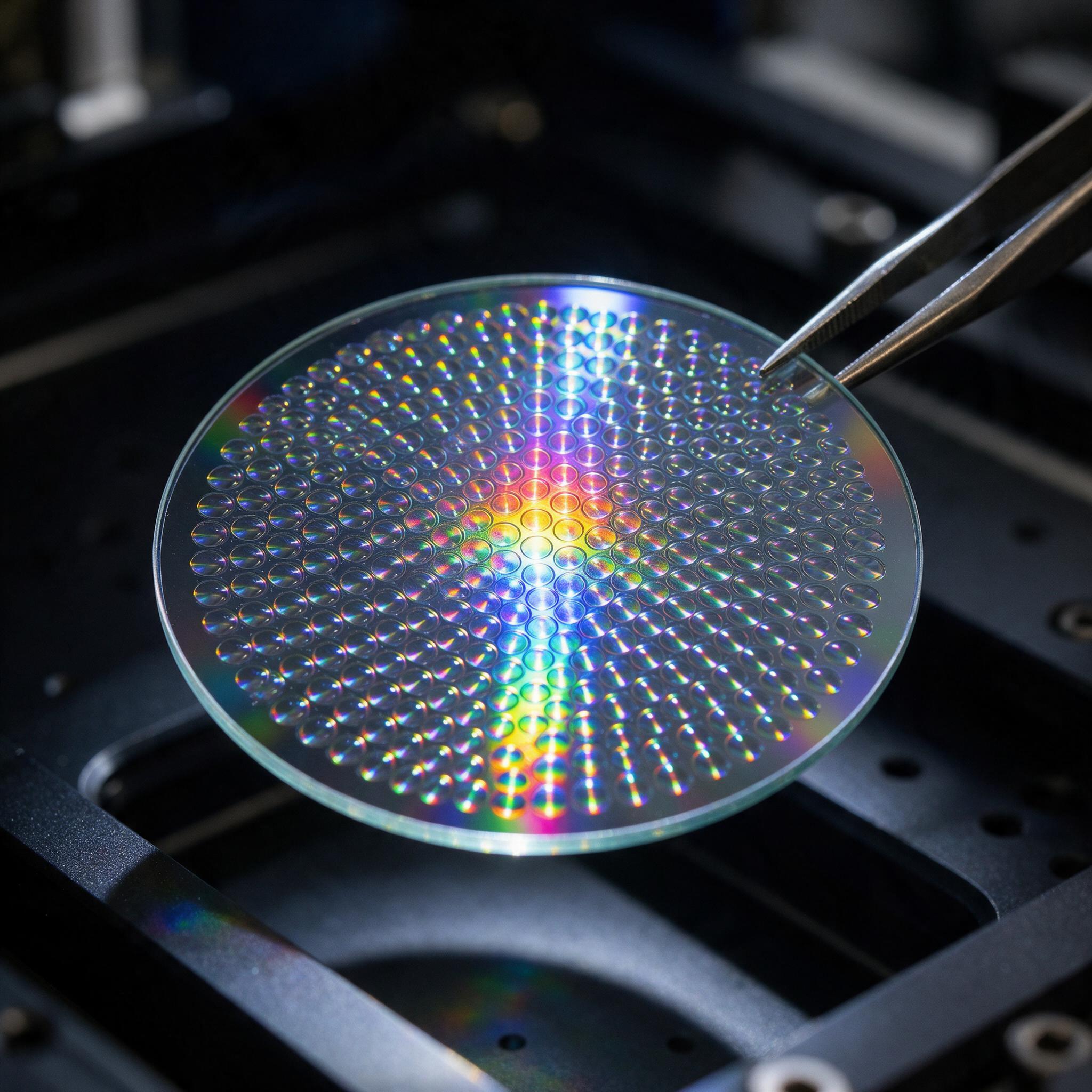
Metalens — flat optics built from nanoscale structures on a wafer — has been discussed as a general replacement for curved optics for years. Reporting from CIOE 2026, published on 18 September, describes a narrower and more credible path: eye tracking, ToF and smart glasses, where the wavelength range is controlled, the aperture is small, and the value of thinness is high. In those applications, metalens sits alongside established routes such as Micro-OLED, Micro-LED and waveguides rather than replacing them.
The practical distinction for a buyer is that a metalens is a wafer-level part with semiconductor-style economics and semiconductor-style qualification. It is attractive when annual volume is high and the optical function is narrow; it is not a drop-in substitute for a broadband imaging lens that must perform across the visible spectrum.
Visible-Light Lenses & Components →
Optics makers are repositioning, not retreating
Consumer imaging demand is cooling while new optical demand is forming elsewhere. On 17 September, Sunny Optical was reported as taking an industrial-investor position in a humanoid robotics start-up, alongside its existing role as a supplier to quadruped and humanoid makers; in the same period, a CNY 2.05 billion high-performance optical adhesive film project was reported to be pushing toward start-up in early 2027. Neither development is a smart-glasses story, but both point to where visible-light optics capacity and know-how are being redeployed: robotics vision and display materials.
How to specify optics for a lightweight wearable
- Specify by function and budget, not by element count. State the modulation transfer target, the field of view and the mass budget, then let the supplier propose the element stack.
- Fix the wavelength band and the coating at the same time. Narrowband filters for depth sensing and broadband AR coatings on the same surface interact; specify both on one drawing.
- Ask for stray-light and ghost-image data. In see-through optics, ghosting is the most common late-stage failure and the hardest to fix after tooling.
- Request environmental durability evidence for coatings. Wearables are exposed to skin oils, humidity and abrasion; the test method matters more than the coating name.
- Treat metalens as a volume programme, not a sample order. If the design needs it, engage on design rules and wafer-level test early; if the requirement is broadband and low volume, moulded aspheres remain the pragmatic choice.
- Confirm the supply chain behind the moulded parts. Mould inserts, glass preforms and coating capacity are the real constraints in asphere supply, not polishing labour.
Sourcing visible-light lenses, aspheres and coatings from China?
TUOLAN TRADE helps overseas buyers translate a wearable or imaging requirement into a manufacturable optical drawing, compare moulded and polished routes on cost and volume, and coordinate sample inspection, coating durability testing and export delivery. Send your specification to sales@tuolango.com.
Sources and disclosure
Figures and technical descriptions are compiled from public internet sources dated September 2026: OFweek Optics Network republishing VR陀螺 analysis on smart-glasses camera reduction published 22 September; OFweek Optics Network reporting on metalens commercialisation paths following CIOE 2026, published 18 September; OFweek Optics Network reporting on Sunny Optical’s industrial investment in a humanoid robotics start-up and on the CNY 2.05 billion optical adhesive film project. Product and investment descriptions are as reported by those outlets and are not independently verified here. Editorial analysis and sourcing guidance in this article are our own assessment, not vendor guidance. TUOLAN TRADE is not affiliated with any company mentioned; company and product names belong to their respective owners.