
Insights
Multi-Cat Recognition: AI Pet Feeders From $129 to $249
INDUSTRY NEWS · SMART PET DEVICES · SEPTEMBER 2026
Within seventy-two hours, Purina’s Petivity launched a cat feeder that identifies up to five cats by face, and PETLIBRO shipped a four-model feeder range from $129.99 to $249.99 whose Vision model recognises up to ten. Multi-cat recognition has become the specification that separates this generation from the last.
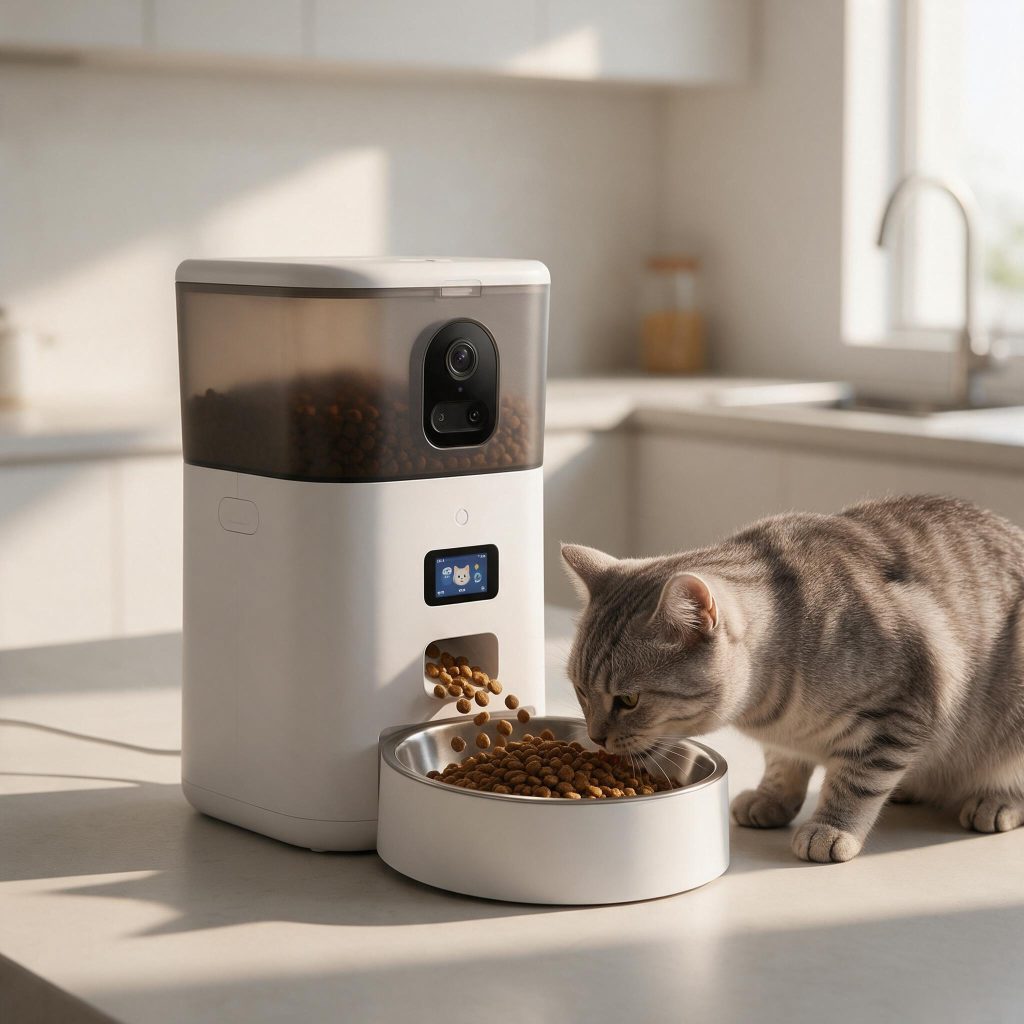
Smart feeders used to compete on portion accuracy and app reliability. That is no longer the differentiator. Petivity, powered by Purina, introduced its Smart Feeder for Cats on 21 September, using sensor technology and a built-in camera to power AI-enabled facial recognition that learns the feeding behaviour of up to five cats. In a multi-cat household it distinguishes how much each individual cat eats, rather than how much food left the hopper.
Petivity’s product development lead Kristin Slater framed the problem directly: how and when a cat eats may matter as much as what it eats, and obesity is one of the most common preventable health issues in cats, often because owners do not know how much their cat is actually eating. To promote the launch, Petivity is running a “Press to Feed” event at Grand Central’s Vanderbilt Hall in New York on 6 October, where visitors press a button to feed real shelter cats in real time.
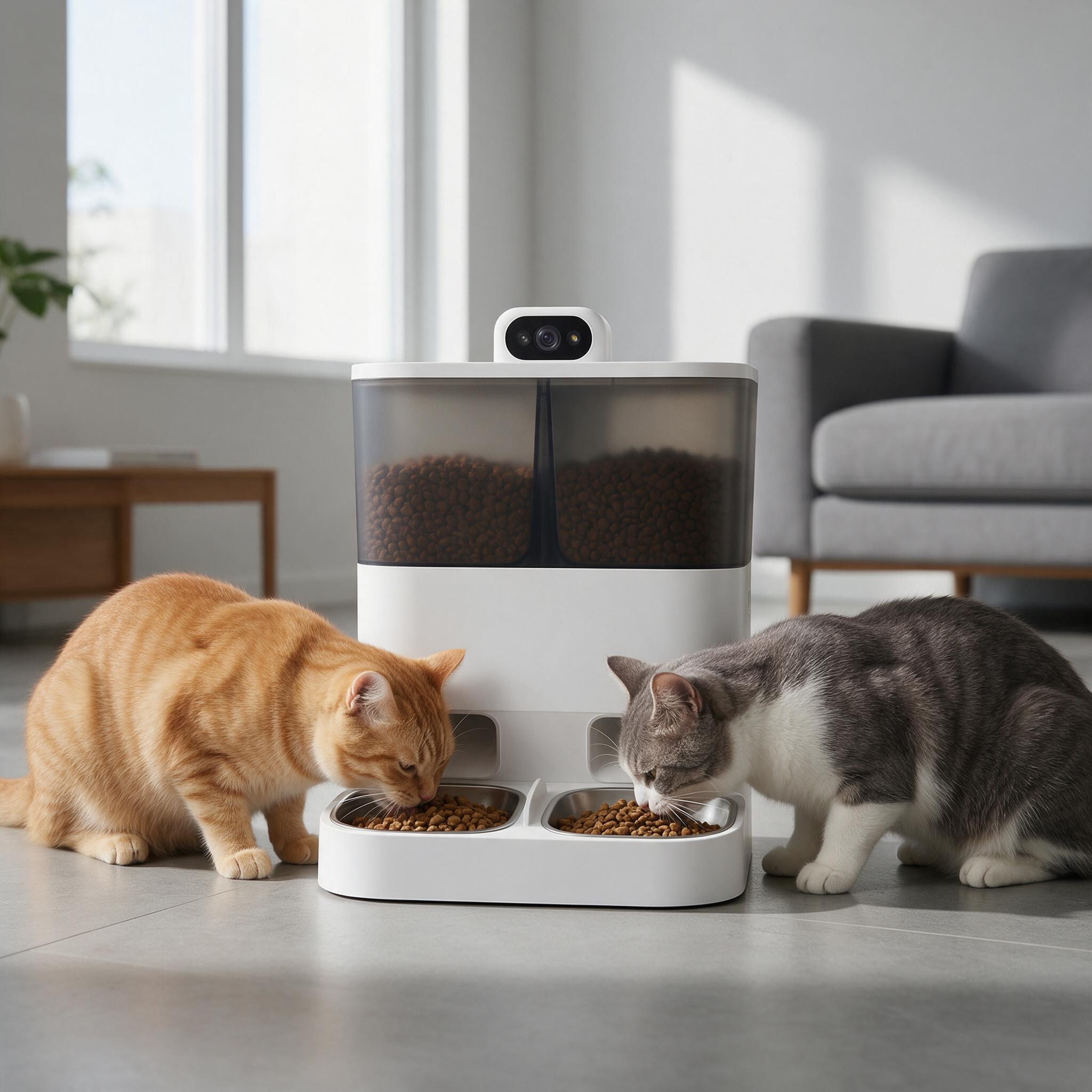
Two days earlier, TechCrunch reviewed PETLIBRO’s Granary 2 series, a four-model dry-food range priced from $129.99 to $249.99. The entry Granary 2 covers app-controlled feeding, precise portioning and intake tracking. The $189.99 Granary 2 Vision adds an AI camera that recognises up to ten cats and tracks each pet’s individual eating habits. The $199.99 Vision Duo targets multi-pet homes with two independent dispensing chutes and bowls. The $249.99 Granary 2 X sits at the top of the range.
The pattern: recognition is the new feature tier
Three things are happening at once. First, the sensing package has become standard: a camera plus a load cell plus edge inference. Second, the differentiator has moved from hardware to a count — how many animals the model can tell apart — which is a software and dataset claim as much as a hardware claim. Third, the price band has consolidated quickly: roughly $130 to $250, with the recognition tier sitting around $190.
This is a familiar trajectory from consumer electronics. Once a sensing capability becomes standard, competition shifts to the analytics layer, and the analytics layer is where subscription revenue lives. Industry analysis published in September put Tractive’s subscriber base at 1.5 million with paid subscription ARR of EUR 100 million, about 80% of total revenue — a valuation anchor set on recurring software rather than hardware.
What this means for pet device sourcing
- Treat the camera module as a core component, not an accessory. Recognition quality sets the marketing claim, so lens, sensor, IR-cut and illumination choices decide whether the product can honestly claim multi-animal identification.
- Ask for accuracy under real conditions. Coat colour similarity, low light, motion and partial occlusion are where recognition claims break. Request test methodology, not just a maximum count.
- Decide who owns the model. The recognition algorithm is the moat. Buying a feeder with an off-the-shelf module means competing on price alone.
- Model the subscription, not just the unit price. The $190 recognition tier only makes sense if it feeds a recurring service. If there is no subscription path, the hardware margin has to carry everything.
- Check the pet-safety and hygiene design early. Food-contact materials, washable parts and motor reliability are the parts that generate returns, regardless of how good the recognition is.
Custom Sourcing & Product Development →
Specifying a smart pet device programme
- Define the recognition claim before the hardware. Number of animals, lighting conditions and accuracy threshold should be written down first; the camera specification follows from them.
- Fix the connectivity and cloud region. Wi-Fi band, provisioning flow and data residency affect both cost and compliance in destination markets.
- Set the subscription boundary. Decide which features are free and which require a plan, before the app is designed. Retrofitting a paywall breaks user trust.
- Specify food-contact and cleaning requirements. Materials, dishwasher tolerance and disassembly time are return drivers in pet hardware.
- Plan for supply of consumables. Filters, desiccant packs and replacement parts are a second revenue line and a support burden — both need an owner.
Developing or sourcing smart pet devices from China?
TUOLAN TRADE helps overseas buyers take a smart pet device from feature definition to a manufacturable specification — matching camera and sensing modules to the recognition claim, coordinating sample builds and test reports, and handling export documentation. Send your requirement to sales@tuolango.com.
Sources and disclosure
Figures are compiled from public internet sources dated September 2026: Nestlé Purina News Center / PR Newswire release of 21 September on the Petivity Smart Feeder for Cats, including the stated recognition of up to five cats, the quoted comment from Petivity product development lead Kristin Slater, and the 6 October Grand Central Vanderbilt Hall event; TechCrunch review dated 19 September of the PETLIBRO Granary 2 series, including the stated four-model range, the price band of $129.99–$249.99, the $189.99 Granary 2 Vision recognising up to ten cats, the $199.99 Vision Duo configuration and the $249.99 Granary 2 X; and a Tianmeiti (tmtpost.com) analysis dated 17 September carrying the Tractive subscriber and ARR figures attributed to public company information. Prices and performance claims are the respective companies’ published figures and are not independently verified here. Editorial analysis and sourcing guidance in this article are our own assessment. TUOLAN TRADE is not affiliated with any company mentioned; company and product names belong to their respective owners.