
Insights
ESA Backs Superconducting Nanowire Single-Photon Detectors for QKD and Laser Comms
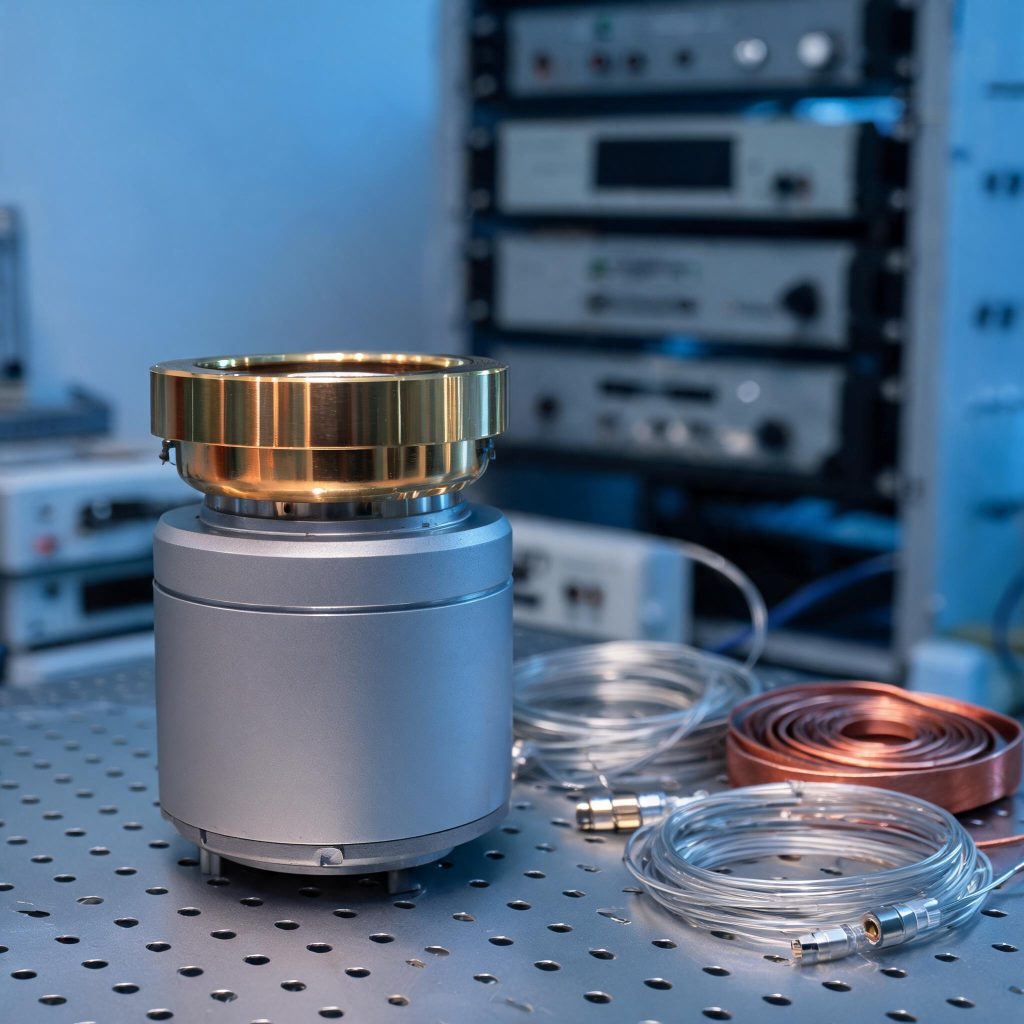
INFRARED & INVISIBLE LIGHT · SINGLE-PHOTON DETECTION · OCTOBER 2026
The European Space Agency has contracted Warsaw-listed Creotech Quantum to design, build and demonstrate a new generation of superconducting nanowire single-photon detectors (SNSPDs) for ground quantum-key-distribution stations and advanced laser communication. Project value is €2.33 million, of which Creotech Quantum’s share is €1.2 million, over a 24-month programme that lifts the technology to TRL 5.
MEMS Consulting (麦妆姓咨询) reported the agreement on 3 October 2026. The project is named HRQKD — superconducting-nanowire-based single-photon detectors for laser communication and quantum key distribution applications — and it marks a new stage in Creotech Quantum’s detector work under ESA contracts. The company takes the role of consortium lead, responsible for electronics hardware and software development, testing and product development strategy.
Why SNSPD and not a SPAD
Single-photon detection is the invisible-light problem at its hardest: recovering a signal so weak that it arrives as individual photons. The two commercial routes are avalanche diodes and superconducting nanowires, and they are not interchangeable.
Avalanche photodiodes, including the SPAD arrays now reaching volume in imaging, are semiconductor devices that multiply a photo-generated carrier inside the material. They are compact, room-temperature-operable and manufacturable in CMOS, which is exactly why they have moved from research instrumentation into consumer and automotive products.
Superconducting nanowire single-photon detectors work differently: a nanometre-scale wire biased just below its superconducting transition is driven out of the superconducting state by a single absorbed photon, producing a detectable voltage pulse. That gives very low dark counts, very low timing jitter and high detection efficiency in the near-infrared — the properties that matter when the link budget is measured in photons rather than milliwatts.
The cost of that performance is infrastructure: SNSPDs operate at cryogenic temperatures, which is why the technology has historically stayed inside physics laboratories and specialised ground stations. The HRQKD project is explicitly about moving from a proof-of-concept prototype to a demonstrator with a higher technology readiness level — in ESA’s framing, validated in an environment representative of its intended industrial application.
Two strategic applications, one detector
The detectors under development target two areas.
Quantum key distribution. Here the detector receives quantum signals at a ground station communicating with a satellite. Detection efficiency and dark-count performance set how much key material can be distilled out of a link, so the detector is not a peripheral component — it is the component that decides whether the link is useful.
Laser communication. Optical links carry far higher data rates than equivalent radio-frequency systems, which is why future satellite constellations depend on them. The programme specifically targets long-distance optical communication where the expected signal is extremely weak, citing links to a lunar base or missions further out into the solar system. At those distances the receiver cannot rely on raw optical power; it has to count photons.
Creotech Quantum CEO Anna Kamińska framed the contract as confirmation of the company’s position in the European quantum technology ecosystem and described SNSPDs as a key component of future secure quantum communication systems and advanced data transmission. She said the new project moves the technology from a proof-of-concept prototype to a higher-maturity demonstrator, shortening the path to commercialisation and large-scale deployment, and that the detector is ultimately expected to serve space, telecom, defence and critical infrastructure applications.
The work sits inside a European policy stack: the HRQKD project is supported through ESA and European Commission programmes including EuroQCI, ARTES, SAGA and ScyLight. EuroQCI is the initiative to build a European secure quantum communication infrastructure spanning both terrestrial networks and satellite links — which is precisely why a ground-station detector programme is being funded alongside the satellites.
Precision Optics & Assemblies Sourcing →
What this means for invisible-light component sourcing
- Detector performance is bought twice — once in the device, once in the optics. A high-efficiency SNSPD in front of an unmatched fibre coupling, a lossy filter or a poorly aligned relay loses exactly the margin the detector was chosen for. Specify coupling efficiency and filter transmission explicitly.
- Narrowband filtering is now a system requirement, not a component detail. Quantum and photon-counting links separate signal from background by wavelength. Filter centre wavelength, bandwidth and out-of-band blocking belong in the same specification as the detector.
- Treat cryogenic-compatible optics as a separate qualification. Anything inside a cryostat has to hold its flatness, coating adhesion and alignment across a wide temperature excursion. Ask for the data at operating temperature, not at room temperature.
- Space and defence programmes buy documentation. TRL progression and ESA contract frameworks imply traceability, environmental test evidence and configuration control. Suppliers without that paper trail will not survive qualification, however good their catalogue numbers look.
- Watch the ground segment, not only the satellite. EuroQCI and similar programmes require ground stations as well as spacecraft, and ground terminals are built in far larger numbers than satellites. That is where repeat optical component demand will land first.
Sourcing photon-counting, laser-communication or cryogenic optics?
Send your wavelength, bandwidth and blocking requirements, coupling or fibre type, operating temperature range, environmental qualification and annual volume to sales@tuolango.com and we will return a qualified-supplier comparison for lenses, filters, windows and fibre assemblies.
Sources and disclosure
Sources: MEMS Consulting (麦妆姓咨询), 3 October 2026, reporting that Creotech Quantum, listed on the Warsaw Stock Exchange, signed an agreement with the European Space Agency to develop and demonstrate next-generation superconducting nanowire single-photon detectors (SNSPD) for ground quantum-key-distribution stations and advanced laser communication systems — total project value €2.33 million with Creotech Quantum’s share at €1.2 million, the project name HRQKD covering single-photon detectors for laser communication and quantum key distribution applications, a 24-month implementation period, the company as consortium lead responsible for electronics hardware and software development, testing and product development strategy, technology readiness level raised to TRL 5 with validation in an environment representative of intended industrial application, two prior ESA contracts in which the team completed a proof-of-concept SNSPD prototype, applications in quantum key distribution at satellite ground stations and in laser communication supporting very long-distance links where expected signals are extremely weak such as communication with a lunar base or missions further into the solar system, CEO Anna Kamińska’s comments on commercialisation and on space, telecom, defence and critical infrastructure applications, and support through ESA and European Commission programmes including EuroQCI, ARTES, SAGA and ScyLight. Background on SPAD versus SNSPD detection principles, procurement and qualification observations are TUOLAN TRADE analysis and are not attributed to any cited source. Edited and analysed by TUOLAN TRADE.