
Insights
Extended-SWIR Imaging Beyond 1.7 µm: What Infrared Lens Buyers Must Specify
INFRARED & INVISIBLE-LIGHT OPTICS
Extended-SWIR is becoming a distinct procurement category: a lens designed only for conventional InGaAs coverage may not deliver the transmission, focus stability or stray-light control required near 2.5 µm.
Why extended-SWIR is receiving attention
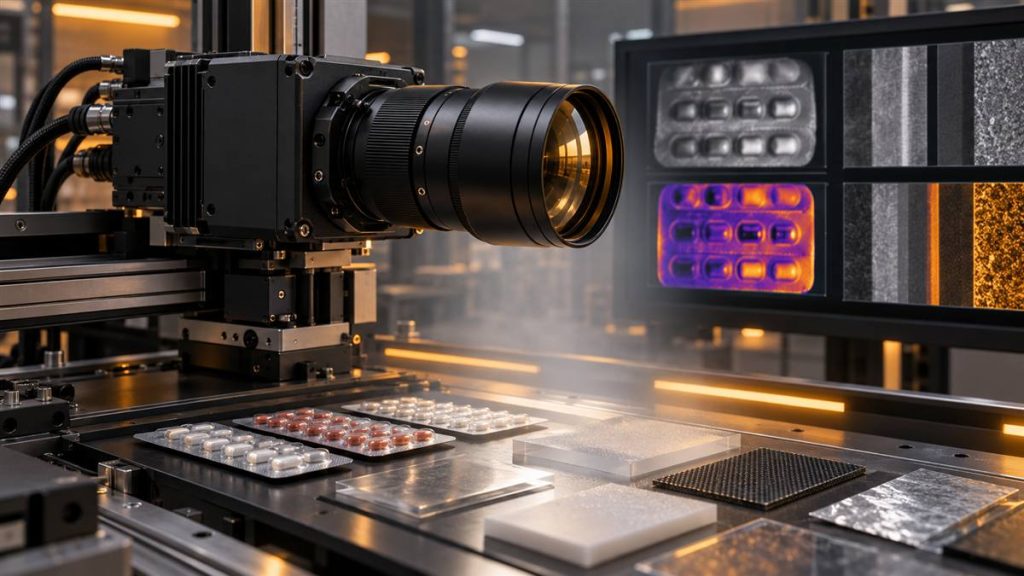
Rostec announced a new generation of detector arrays covering visible-to-short-wave infrared imaging, citing uses in navigation through haze and smoke, non-destructive pharmaceutical inspection and machine vision. The sourcing implication is broader than the sensor itself: once the required response extends beyond the common 0.9–1.7 µm band, the optical train must be reviewed as a system.
Commercial eSWIR modules illustrate the change. AIM lists cooled MCT modules covering 0.9–2.5 µm, including a 640 × 512 format with 10 µm pixels and 100 Hz full-frame operation. Those figures are product-specific, not universal targets, but they show why an RFQ must identify the exact detector and spectral band.
What changes in the lens specification
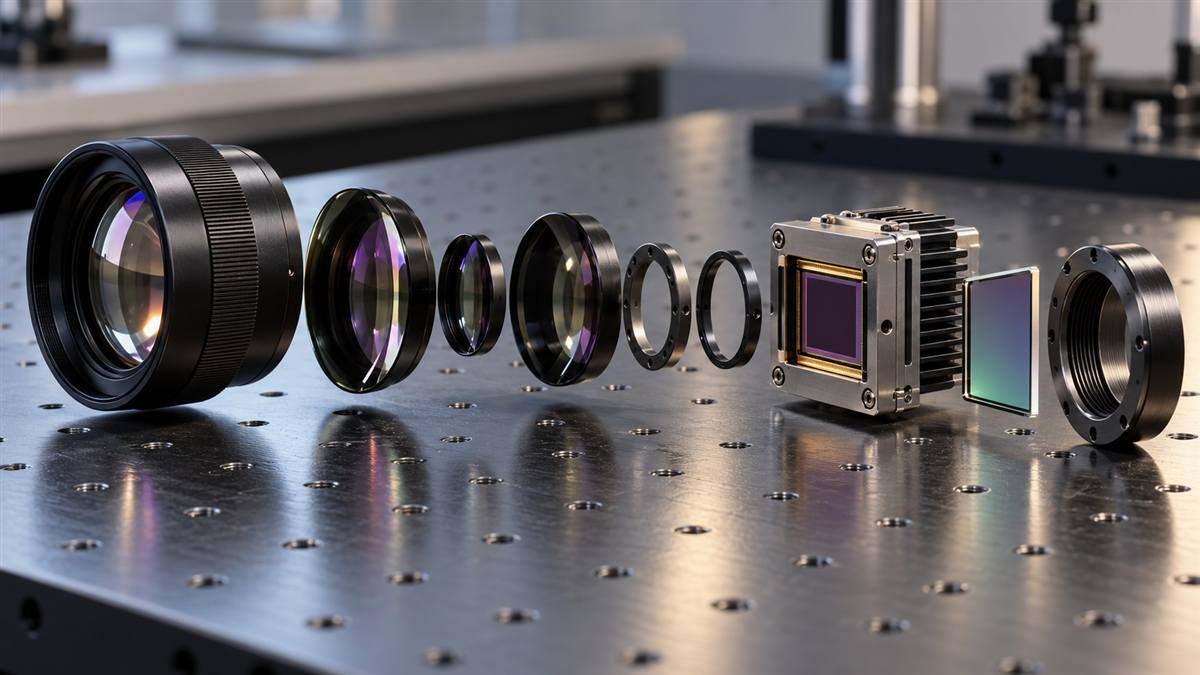
For an extended-SWIR infrared lens assembly, “SWIR compatible” is no longer precise enough. TUOLAN’s MWIR and LWIR lens catalog covers different spectral bands and does not establish eSWIR compatibility. For a custom eSWIR project, review the optical coating requirements and material transmission separately; availability requires project confirmation. The RFQ should state the required wavelength limits, detector format and pitch, focal length, F-number, working distance, field of view, distortion limit and environmental range. Transmission must be defined across the full operating band rather than quoted at one convenient wavelength.
Practical eSWIR RFQ checklist
- Give the detector model, active area, pixel pitch and any cold-shield geometry.
- State whether coverage is 0.9–1.7 µm, 0.9–2.5 µm or visible-to-2.5 µm.
- Specify filter position, coating band and acceptable out-of-band leakage.
- Request MTF at the actual detector sampling frequency and operating temperature.
- Define focus compensation, sealing, humidity and contamination requirements.
For industrial inspection, the application sample also matters. Moisture, polymers, coatings and pharmaceutical ingredients do not produce the same contrast at every wavelength, so validation should use the buyer’s real material set.
Need a sourcing-ready specification?
TUOLAN TRADE can help translate performance targets into an RFQ, supplier comparison and sample-validation plan.
Primary source: Rostec announcement, 30 September 2026; technical context cross-checked against AIM eSWIR module data. Facts and dates checked on 8 October 2026.
Edited and analysed by TUOLAN TRADE.