
Insights
A 28,000-Hour Cooled MWIR Core: InfraTec’s ImageIR c7300
INFRARED & INVISIBLE LIGHT · COOLED MWIR IMAGING · OCTOBER 2026
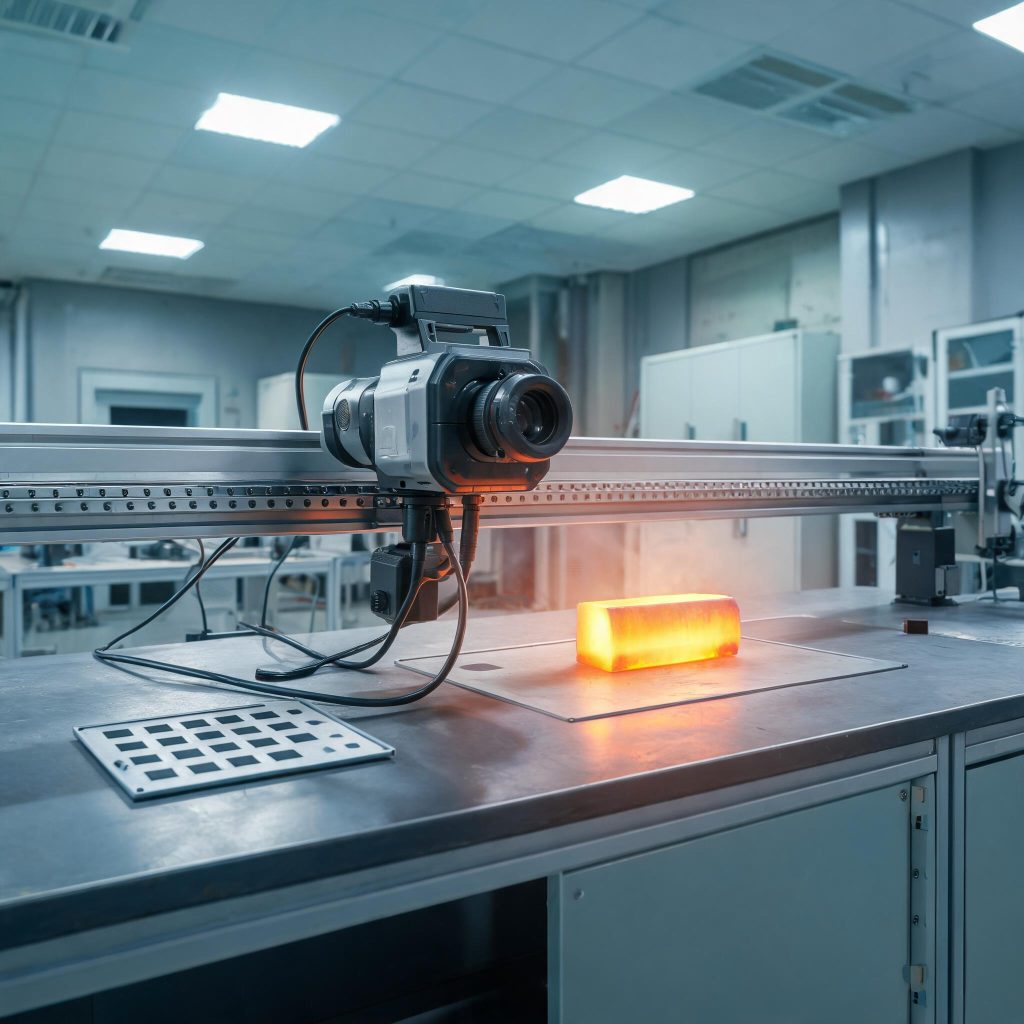
InfraTec has opened a new Compact-Line family with the ImageIR® c7300, a cooled photon-detector camera built around an MWIR long-life cooler rated at 28,000 hours average service life. The German manufacturer is not chasing the fastest frame rate in the catalogue — it is selling a predefined configuration for 24/7 radiometric measurement. For anyone buying infrared lenses, windows and coatings, that is a specification sheet worth reading closely.
The launch was reported by Novus Light on 2 October 2026. InfraTec positions the c7300 as the first model in a Compact-Line series in which cameras ship with a predefined configuration focusing on what most measurement tasks actually need: reliable radiometric temperature measurement, good image quality, high frame rates with snapshot image acquisition, and straightforward integration into existing processes. Individual parameter optimisation is traded away for cost efficiency.
The cooler is the headline number
The published figure that matters most operationally is the cooler life: a heavy-duty MWIR long-life cooler with an average service life of 28,000 hours, which InfraTec presents as the basis for reliable, cost-effective measurement in 24/7 operation.
That number reframes the ownership economics of a cooled infrared camera. In a cooled photon detector, the Stirling cooler is a wearing part; MTBF governs whether a camera deployed on a production line or an outdoor monitoring station is a capital asset or a maintenance contract. A 28,000-hour average service life is roughly three years of continuous duty before the average unit reaches end of cooler life — and that is the figure a maintenance planner should carry into a total-cost-of-ownership model rather than the purchase price alone.
A five-position filter wheel and real IR glass in front of the sensor
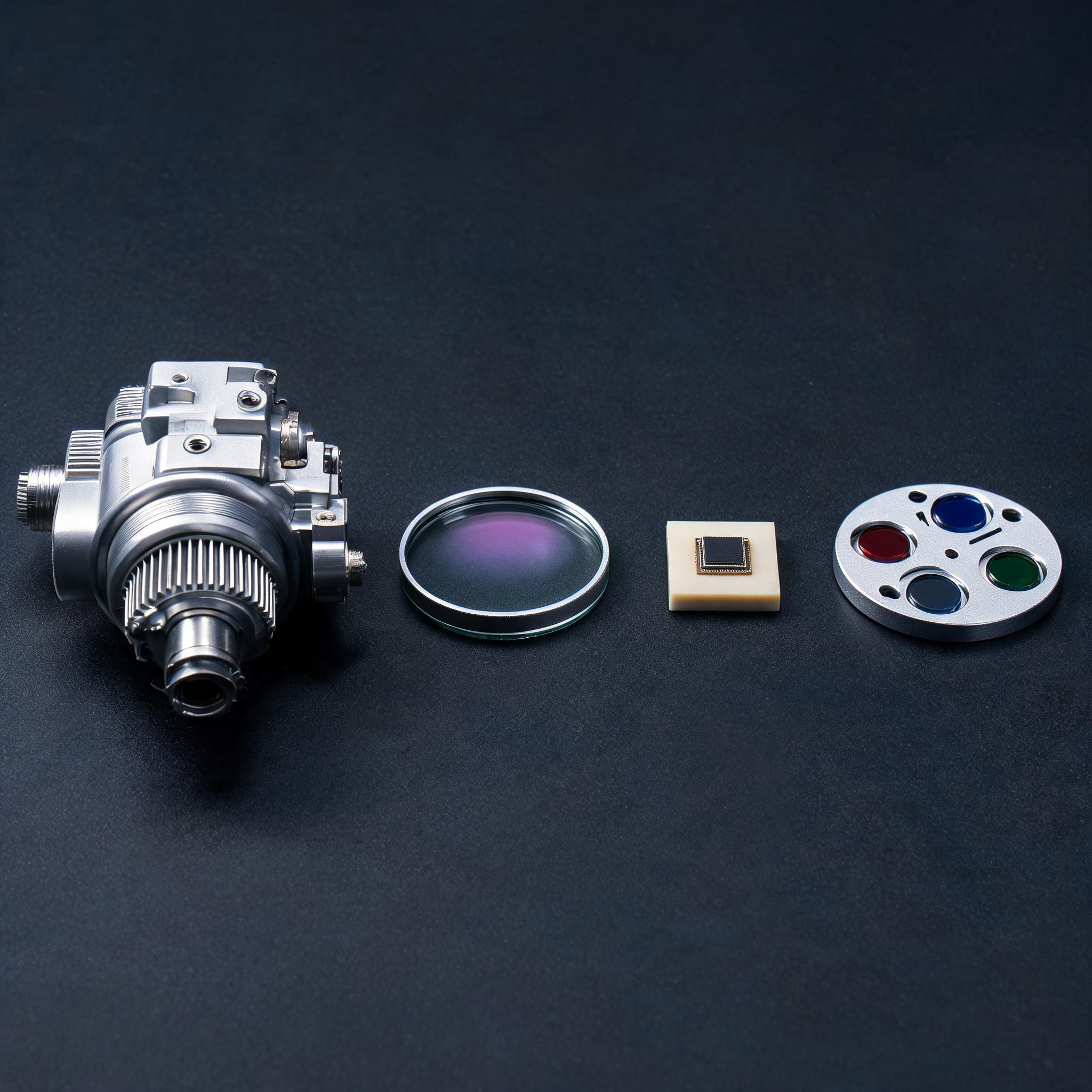
The c7300 carries an integrated five-position filter wheel. InfraTec quotes a standard measurement range of −10…1,500 °C, optionally extendable to 3,000 °C. A filter wheel is how a single camera is made to serve multiple spectral tasks — measuring through different bands, blocking reflections, or separating surface from bulk temperature — so the filter set becomes part of the specification rather than an accessory.
The lens side is deliberately conventional: InfraTec states that a range of high-quality infrared lenses with fixed focal length is available to accommodate the size of the test object and the level of detail to be analysed. Fixed focal length lenses remain the highest-transmission, lowest-cost way to fill an infrared detector, and they are the reason a cooled camera platform still generates recurring orders for IR lens element and coating suppliers.
Plug-and-play integration is now a camera feature
The interface set on the c7300 is a fair indicator of what the infrared camera market now treats as baseline for industrial deployment:
- On-camera calibration data for easy plug-and-play installation — calibration travels with the camera rather than living in a commissioning document.
- Gigabit Ethernet for reliable, fast data transmission.
- GenICam / GigE Vision for software integration and control.
- Internal trigger output and external trigger processing, described as highly precise and repeatable — the feature that puts a thermal camera inside a synchronised test bench or automation cell rather than beside it.
- Power over Ethernet or a wide-range power supply, plus configuration and operation through a web interface.
- Compact dimensions, low weight and a wide range of mounting options for integration into systems, test benches and automation solutions.
InfraTec also offers DIECAST-CHECK, an automation solution aimed at in-process inspection in die casting — a reminder that the commercial pull for cooled MWIR measurement is concentrated in industrial quality control, research and monitoring.
What this means for infrared optics buyers
- Ask for cooler life in the same document as the optical specification. A cooled IR system is judged on both, and a 28,000-hour class cooler is now the reference point in the compact industrial segment. If a supplier cannot quote cooler life, the quotation is not comparable.
- Specify the filter set, not just the band. With a five-position wheel, the filters become the application flexibility. Buy coatings with measured transmission and blocking data per position, and confirm the substrate and clear-aperture dimensions match the wheel.
- Plan lenses around fixed focal lengths where the application allows. Fixed focal length IR lenses deliver the transmission and cost that zoom assemblies cannot match. Reserve motorised zoom for applications that genuinely change working distance.
- Check the temperature range before the lens coating is frozen. A camera specified to 3,000 °C raises radiance through the aperture dramatically, and the optical stack — not only the detector — has to survive and stay calibrated.
- Treat triggering and calibration as procurement requirements. On-camera calibration data and repeatable hardware triggering decide whether the camera drops into an existing automation cell or needs bespoke engineering time.
Sourcing MWIR/LWIR lenses, windows or filters?
Send your band, detector format, focal length or field of view, aperture, temperature range, filter positions and annual volume to sales@tuolango.com and we will return a qualified-supplier comparison for lens elements, windows and coated filters.
Sources and disclosure
Sources: Novus Light, 2 October 2026, reporting the launch of the InfraTec ImageIR® c7300 as the first model in the Compact-Line series of cooled infrared cameras — cooled photon detector technology, MWIR long-life cooler with an average service life of 28,000 hours for 24/7 operation, preconfigured cameras for cost-conscious users, an integrated 5-position filter wheel, a standard measurement range of −10…1,500 °C optionally extendable to 3,000 °C, fixed-focal-length high-quality infrared lenses selected to match test-object size and required detail, on-camera calibration data for plug-and-play installation, GigE data transmission with GenICam / GigE Vision software integration and control, highly precise and repeatable internal trigger output and external trigger processing, operation and configuration via a web interface, power via wide-range supply or PoE, compact size, low weight and wide mounting options for integration into systems, test benches and automation, and the DIECAST-CHECK automation solution. Procurement, qualification and total-cost-of-ownership observations are TUOLAN TRADE analysis and are not attributed to any cited source. Edited and analysed by TUOLAN TRADE.