
Handheld low-light observation optics · Eyepiece
KE902501 25 mm 10× Wide-Field Eyepiece
A 25 mm optical eyepiece component for handheld low-light observation systems, with 10× magnification, a ≥14 mm axial exit pupil and a ≥40° field for a 17.5 mm image format.
This is an optical component for integration into a complete viewing system.
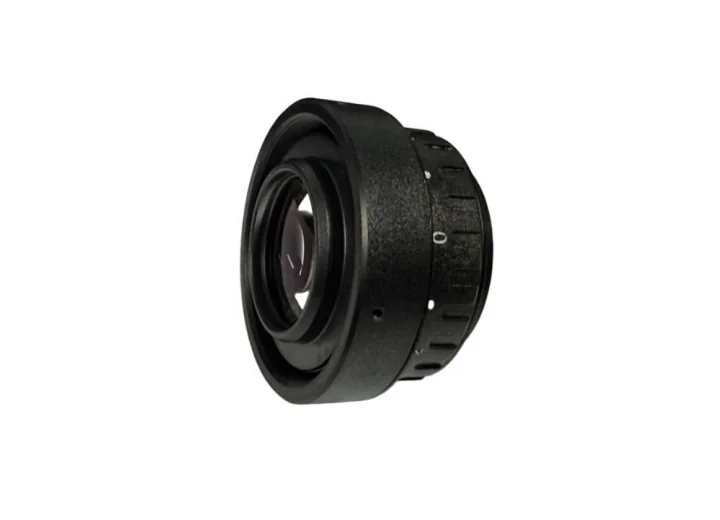
KE902501 reference specifications
| Parameter | Source specification |
|---|---|
| Model | KE902501 |
| Optical function | Eyepiece |
| Focal length | 25 mm |
| Magnification | 10× |
| Axial exit-pupil diameter | ≥14 mm |
| Field of view | ≥40° for a 17.5 mm image format |
| Lens material | Optical glass, including an aspheric element |
| Distortion | ≤−5.1% at a 20° semi-field angle |
| Weight | ≤54 g |
| Environmental reference | IP67; waterproof to 20 m for at least 2 hours |
Reference values are subject to confirmation against the approved drawing, mechanical interface and acceptance specification for each project.
Designed for compact low-light viewing assemblies
The KE902501 is an eyepiece component rather than a complete night-vision device. Its 25 mm focal length, 10× magnification and ≥14 mm axial exit pupil make it suitable for engineering evaluation in compact direct-viewing and handheld low-light observation systems.
For a matched 25 mm front objective reference, review the KN902501 low-light objective. Detector, image intensifier, display, housing and interface compatibility must be verified at system level.
Information required for an RFQ
- Image format and required field of view
- Required eye relief, exit pupil and diopter arrangement
- Mechanical interface and available envelope
- Operating environment, sealing and test requirements
- Prototype and production quantities
Frequently asked questions
Is KE902501 a complete handheld observation device?
No. KE902501 is an optical eyepiece component intended for integration into a complete viewing system.
Can KE902501 be paired with KN902501?
They can be evaluated as a 25 mm objective-and-eyepiece optical combination. Final compatibility depends on the intermediate imaging device, optical spacing, mechanics and required system performance.