
Insights
VIS–NIR Low-Light Objective Lens Selection: Band, F-Number and Sensor Matching
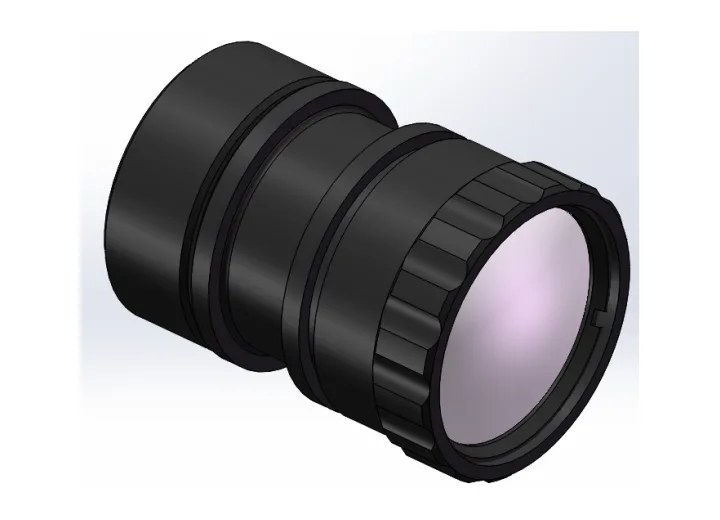
Low-light visible and VIS–NIR objective lenses must balance photon throughput (F-number and transmission), spectral correction across visible-to-near-infrared light, and exact sensor-format matching. Unlike standard visible camera lenses that lose focus when switching to 850 nm or 940 nm near-infrared illumination, VIS–NIR objectives hold image quality across extended bands such as 450–1000 nm or 480–950 nm. This guide compares the three published low-light objectives in the TUOLAN TRADE visible and VIS–NIR catalog and outlines the inputs required for an OEM RFQ.

1. Published Low-Light Objective Lens Comparison
All parameters below are taken verbatim from our published catalog entries on Visible & VIS–NIR Objective Lenses. Fields not published in a catalog entry are marked accordingly rather than assumed.
| Objective reference | Focal length / F/# | Working band | Sensor / Detector ref | FOV / Distortion | Weight / Sealing |
|---|---|---|---|---|---|
| 25 mm Lightweight Low-Light | 25 mm / F/≤1.23 | Not published on record | 640 × 512 / 12 μm (17.5 mm format) | ≥40°; ≤−4.45% at 20° | ≤41.2 g; waterproof 20 m (≥2 h) |
| 22.6 mm VIS–NIR Low-Light | 22.6 mm / F/1.3 | 450–1000 nm (≥94% T) | 1920 × 1080 / 12 μm | 53.4° × 31.8°; 2.45% | ≤43 g; Ø26.4 × 38.83 mm; front IP67 |
| 9.8 mm Ultra-Wide VIS–NIR | 9.8 mm / F/2.4 | 480–950 nm (≥94% T) | 1920 × 1080 / 12 μm | 113.2° × 71.2°; −27% | ≤60 g; Ø26 × 37.82 mm; front IP67 |
For lightweight F/1.23 low-light assemblies, also see our published KN902501 25 mm F/1.23 low-light objective lens page.
2. Key Optical Trade-Offs: F-Number, Band Width and Field of View
- Fast aperture (F/1.23–F/1.3) vs. ultra-wide coverage (F/2.4): The 25 mm (F/≤1.23) and 22.6 mm (F/1.3) objectives maximize light collection on low-light sensors while keeping distortion low (2.45% to ≤−4.45%). Extending horizontal FOV to 113.2° on the 9.8 mm reference trades aperture speed (F/2.4) and increases barrel distortion (−27%), which is typically corrected in downstream software when wide scene awareness is the priority.
- Extended 450–1000 nm vs. 480–950 nm correction: Broadband VIS–NIR coatings (≥94% average transmission on both 1080p references) and apochromatic/achromatic glass pairs keep day-visible and night-NIR focus aligned without refocusing between daylight and 850/940 nm illumination.
- Environmental sealing boundary: Front-element IP67 protects outdoor and handheld housings against dust and water jets (−40 to +60 °C operating range), whereas submersible or marine enclosures require deeper pressure sealing such as the 20 m (≥2 h) reference on the 25 mm lightweight assembly.
3. How Objective Selection Connects to the Viewing Eyepiece
In a complete digital night-vision or electro-optical viewing system, the objective lens forms an image on the CMOS/low-light sensor while the OLED eyepiece magnifies the microdisplay for the human eye. Keeping both ends matched—sensor FOV on the front, microdisplay diagonal and eye relief on the rear—avoids unexpected system magnification errors and edge vignetting.
4. RFQ Checklist for Custom or Reference VIS–NIR Objectives
- Sensor specification: resolution, pixel pitch, active area diagonal, chief-ray-angle limit and cover-glass thickness.
- Working spectral band: exact day/night wavelengths (e.g. 450–1000 nm or 480–950 nm) and minimum average transmission.
- Optical targets: focal length, target FOV, maximum F-number, MTF spatial frequency, relative illumination and distortion limit.
- Focus & mechanics: manual vs. fixed focus, close-focus distance, flange focal distance, mount thread and weight ceiling.
- Environment & inspection: operating/storage temperature, IP67 or pressure sealing and required sample test reports (aligned with ISO 10110-5:2026, ISO 10110-7:2017 and ISO 9211-1:2024).
Last engineering review: November 2026.
5. Frequently Asked Questions
Why can a standard visible lens lose sharpness under 850 nm or 940 nm NIR illumination?
Glass refractive index changes with wavelength. Without VIS–NIR chromatic correction and broadband AR coatings, near-infrared light focuses at a different plane than visible light, causing defocus and reduced contrast.
When should I choose the 22.6 mm F/1.3 objective over the 9.8 mm F/2.4 ultra-wide objective?
Choose the 22.6 mm F/1.3 objective when low-light sensitivity, lower distortion (2.45%) and narrower 53.4° × 31.8° target detail matter most; choose the 9.8 mm F/2.4 objective when ultra-wide 113.2° × 71.2° situational awareness is required.
Does the 25 mm lightweight objective publish a specific spectral band?
No working band is published on the current catalog record for the 25 mm lightweight reference. Confirm the target spectral range and AR coating curve directly during RFQ review.
What is the difference between front-element IP67 sealing and 20 m waterproofing?
Front-element IP67 seals the exposed lens barrel face against dust and temporary immersion when integrated into a sealed housing. The 20 m (≥2 h) reference addresses deeper pressure-sealed assemblies.
How can I request a quote or drawing review for a VIS–NIR objective lens?
Send your sensor datasheet, working band, target FOV, F-number, mount interface and estimated quantity via our technical RFQ form. TUOLAN TRADE coordinates engineering review and sourcing with selected manufacturing facilities.
Explore related optical routes: Visible & VIS–NIR Objective Lenses and Eyepieces · OLED Eyepiece Selection Guide · Chief Ray Angle & Sensor Matching · Working F-Number in Close-Range Imaging