
Insights
China Targets 1 Million 50G-PON Ports by 2030: Optical Access Sourcing

FIBER OPTICS · PON & OPTICAL ACCESS · OCTOBER 2026
China’s Ministry of Industry and Information Technology has written a number into the country’s five-year ICT plan: 1 million 50G-PON ports by 2030, against roughly 20,000 in 2025. That is a fifty-fold build. The standards are finished, the chips and modules are described as mature, and the blockers are cost, power and yield — not physics.
According to C114’s 29 September 2026 report on the sector, the Information and Communications Industry 15th Five-Year Plan issued by MIIT lists thirteen headline indicators. One of them is that China’s installed base of 50G-PON ports reaches 1 million by 2030. The comparable 2025 figure is 20,000. It is the first time 50G-PON appears as a quantified indicator inside a national five-year plan.
50G-PON is the industry name for the ITU standard G.9804, which specifies an optical access network delivering 50 Gbit/s downstream with at least 12.5 Gbit/s upstream. Light Reading reported the same target on 2 October 2026, noting that most operators outside China are still trialling the technology while China has now set a deployment number.
The standards work is finished
The most useful signal out of CIOE 2026 in Shenzhen was that this is no longer a standards debate. Both the ITU-T and China’s CCSA main specifications for 50G-PON are now fully completed, and the Chinese industry is working from the results of 136 gigabit optical network pilot projects completed during 2025. Those pilots deployed 50G-PON ultra-wideband access, FTTR and Wi-Fi 7 coordination, and optical-network-plus-AI integration, and produced commercial applications including cloud PCs, cloud gaming, industrial optical inspection, AI ultra-high-definition surveillance, model training and inference, and integrated sensing and communication.
CAICT vice president Ao Li described the supply chain as ready along three dimensions: higher-power transmitter devices with improved performance and capacity, higher-sensitivity receivers, and stronger module design and development capability. Laboratory verification of symmetric single-system throughput has come close to the theoretical value, and mixed symmetric/asymmetric ONU networking has been shown to work.
Fiber Optic Cables & Modules Sourcing →
Cost, power and yield are the real gate
Speakers at the CIOE 2026 conference on gigabit optical access converged on the same verdict: the technology has passed, and the remaining problems are cost, power consumption, yield and demand pull.
The live-network upgrade path is the awkward part. China Telecom Research Institute’s Zhang Dezhi said it took more than two years of work with the industry to solve the migration of massive existing EPON terminals to gigabit-class access. His assessment is that 50G-PON core ASIC chips, optical modules and devices are now fully mature, that normalised terminal products have commercial capability, and that large-scale delivery arrives in 2027. He also named the two biggest equipment pain points directly: too high a cost and too much power consumption, with DML deployment and DSP architecture optimisation as the levers for bringing both down.
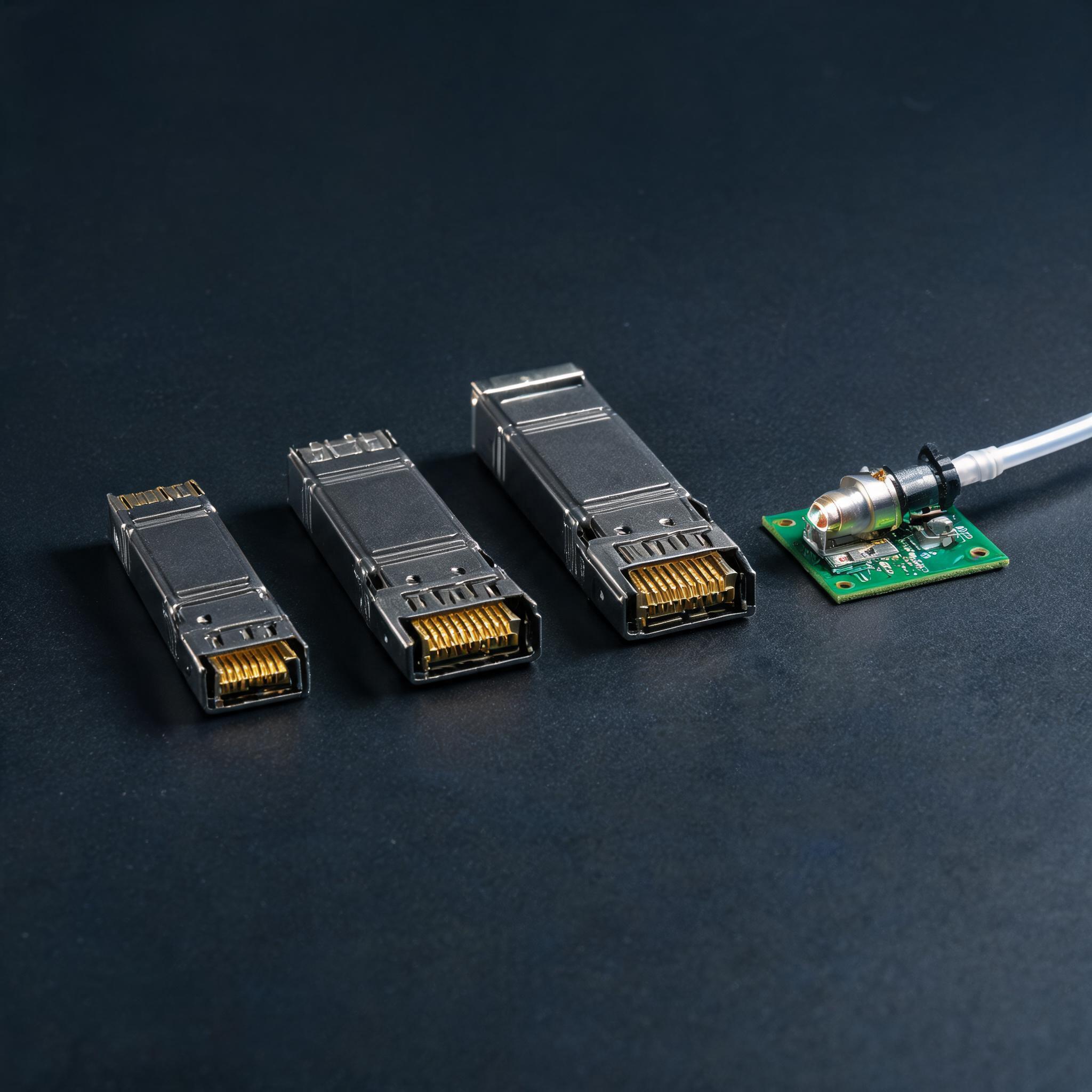
Yield is concentrated in the optics. Accelink’s marketing director Lin Tao set out the component road map: an asymmetric first generation in 2023, SFP-DD miniaturised optical components in 2024, and a symmetric third generation now arriving in 2026. OLT ports are settling on tri-mode symmetric SFP-DD, ONUs start asymmetric with symmetric introduced on demand, and the BOSA architecture is favoured to control cost. The catch, in his words, is that a combo PON port is a four-way device while 50G-PON is a six-way device, so production is essentially a fight over transmit power and receiver sensitivity — and the coupling power budget is the main constraint on mass-production yield for tri-mode miniaturised OLTs.
AI has rewritten the traffic model — and it is also draining capacity
The demand argument for 50G-PON used to be about higher downstream speeds. It has flipped. Zhang Dechao, deputy head of basic network research at the China Mobile Research Institute, said token-based services have “completely restructured the traffic model of optical networks”. The old downlink-dominated asymmetric pattern has broken: uplink now accounts for 40%–50% of network traffic, and symmetric bandwidth has become the mainstream. He cited projections that by 2035 AI inference will account for 25% of total traffic, driving more than 63% growth in overall network traffic.
That demand is not arriving free of competition. Accelink’s Lin Tao warned that AI is draining upstream production capacity and operator capex away from access networks: “No one is willing to spend money on production capacity or R&D investment in PON-related technologies. Basically, everyone is going all in on AI.” In other words, the same wave that creates the need for 50G-PON also competes with it for fibre, lasers, assembly lines and engineering headcount.
Industrial access is the other concrete pull. Industrial PON is growing at roughly 14.8% a year and continues to displace traditional industrial Ethernet, with requirements that go beyond consumer broadband: millisecond-class latency and, in some plants, microsecond-class end-to-end delay, nanosecond clock synchronisation and 10 Gbit/s bandwidth. FibreHome reported pilot applications based on 50G-PON at a gigabit factory in Yuxi, Yunnan, covering intelligent video inspection and gigabit environmental monitoring circuits.
What 50G-PON means if you buy access optics
- Design to the symmetric case, quote the asymmetric one. Uplink is running at 40%–50% of traffic and the specification is still converging. A supplier that can only build the asymmetric ONU variant will be quoting a product that has a shorter commercial life than the OLT it connects to.
- Treat yield, not catalogue specs, as the qualification question. The published numbers are achievable; the coupling power budget is what decides how many units leave the line. Ask for production yield data on the exact tri-mode configuration you intend to buy, not on a demo build.
- Power budget is now a bill-of-materials decision. Cost and power are the two named blockers, with DML and DSP optimisation as the levers. That puts thermal design, drive scheme and DSP choice on the sourcing agenda rather than in the vendor’s closed box.
- Plan around a 2027 delivery window. Core ASICs, modules and devices are described as mature with normalised terminals ready, and volume delivery is expected from 2027. Buyers who need early allocation should be qualifying sources now, while programmes are still in pilot scale.
- Watch the connector and fibre construction, not just the transceiver. A fifty-fold port build-out multiplies ODN fibre, splitters, connectors and patch cords alongside the electronics. Access optics and access cable should be sourced against one rolling forecast.
Sourcing PON optics, fibre or access cable?
Send your port count, symmetry requirement (symmetric or asymmetric), power budget, fibre construction and annual volume to sales@tuolango.com and we will return a qualified-supplier comparison with lead times.
Sources and disclosure
Sources: C114 report, 29 September 2026, on the MIIT Information and Communications Industry 15th Five-Year Plan indicator of 1 million 50G-PON ports by 2030 against 20,000 in 2025, the 136 gigabit optical network pilot projects completed in 2025, the completion of ITU-T and CCSA main standards, and comments from CAICT, China Telecom Research Institute, China Mobile Research Institute, China Unicom Research Institute, Accelink and FibreHome at CIOE 2026. Light Reading, 2 October 2026, on the same 2030 target, the G.9804 definition of 50 Gbit/s downstream and at least 12.5 Gbit/s upstream, the 136 pilot projects, uplink at 40%–50% of traffic, AI inference at 25% of traffic by 2035, and Accelink’s warning on upstream capacity and capex. Procurement, qualification and supply-chain observations are TUOLAN TRADE analysis and are not attributed to any cited source. Edited and analysed by TUOLAN TRADE.