
Insights
LWIR Lens Selection Guide for 1280×1024 / 12 μm Uncooled Detectors (14 mm – 100 mm)
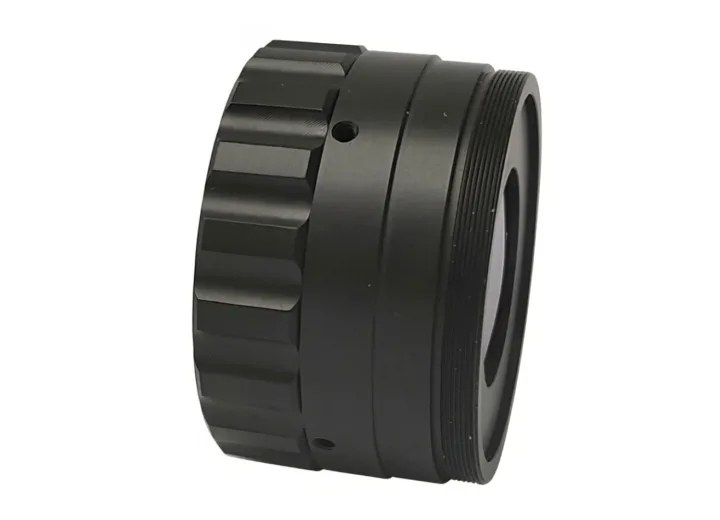
Choosing an 8–12 μm LWIR lens for a 1280 × 1024 / 12 μm uncooled detector requires matching a larger 19.66 mm sensor diagonal—not reusing a 640 × 512 image circle. A lens designed only for 640 × 512 / 12 μm (9.83 mm diagonal) will vignette or lose edge MTF on a 1280 × 1024 array. This engineering guide compares all twelve published 1280 × 1024 / 12 μm LWIR reference lenses in the TUOLAN TRADE MWIR & LWIR infrared lens catalog—spanning 14 mm wide-angle to 100 mm long-range—so OEM and distributor teams can select focal length, focus architecture and front-element coating before requesting a quote.

1. Complete 12-Model Comparison: 1280 × 1024 / 12 μm LWIR Lenses (14 mm – 100 mm)
Every specification below is taken verbatim from our published catalog records. All twelve references operate across 8–12 μm (LWIR), −40 to +60 °C operating temperature, with front-element IP67 sealing reference.
| Published model | Focal / F/# | Field of view | Focus / DOF | Coating & Avg T | Distortion / Weight |
|---|---|---|---|---|---|
| 14 mm F/1 (KI801411) | 14 mm / F/1 | 59° × 48° | Athermalized; 8 m–∞ | DLC; ≥84% | −6%; ≤50 g |
| 16.8 mm F/1 (KIA016802) | 16.8 mm / F/1 | 50.9° × 41° | Athermalized; 20 m–∞ | DLC; ≥86% | −6%; ≤61 g |
| 20 mm F/1 (KIA002001) | 20 mm / F/1 | 42° × 34.2° | Athermalized; 10 m–∞ | DLC; ≥85% | −1.7%; ≤65 g |
| 25 mm F/1.0 High-Res | 25 mm / F/1.0 | 34.2° × 27.6° | Athermalized; 20 m–∞ | AR / HD; ≥86% | 1%; ≤120 g |
| 35 mm F/1 (KI803512) | 35 mm / F/1 | 24.8° × 19.9° | Athermalized; 25 m–∞ | HD; ≥89% | 1%; ≤111 g |
| 50 mm F/1 (KI805011) | 50 mm / F/1 | 17.5° × 14° | Athermalized; 40 m–∞ | HD; ≥90% | 3%; Ø60 × 47.46 mm |
| 55 mm F/1 (KI805511) | 55 mm / F/1 | 15.9° × 12.7° | Athermalized; 90 m–∞ | AR; ≥91% | 2%; ≤345 g |
| 60 mm F/1 Manual (KIS006001) | 60 mm / F/1 | 14.6° × 11.7° | Manual; 5 m–∞ | DLC; ≥86% | 0.2%; ≤330 g |
| 70 mm F/1 (KI807011) | 70 mm / F/1 | 12.5° × 10° | Athermalized; 70 m–∞ | DLC; ≥86% | 0.15%; ≤340 g |
| 75 mm F/1 Manual (KIS007508) | 75 mm / F/1 | 11.7° × 9.4° | Manual; 10 m–∞ | DLC; ≥86% | 1.6%; ≤360 g |
| 90 mm F/1.3 (KI809011) | 90 mm / F/1.3 | 9.8° × 7.8° | Athermalized; 100 m–∞ | DLC; ≥86% | 2%; ≤400 g |
| 100 mm F/1.2 Athermalized | 100 mm / F/1.2 | 8.8° × 7° | Athermalized; 150 m–∞ | AR / HD; ≥90% | 1%; ≤410 g |
2. Angular Resolution (IFOV) and Ground Sampling for 12 μm Pixels
Instantaneous field of view is a pure geometric ratio: IFOV (mrad) = pixel pitch (12 μm) ÷ focal length (mm). Multiplying IFOV by distance gives the linear ground sample covered by one pixel (actual detection or identification range also depends on NETD, target contrast and atmospheric transmission, so no fixed DRI distance is claimed here):
| Focal length | Geometric IFOV (12 μm) | 1 pixel at 100 m | 1 pixel at 500 m | 1 pixel at 1,000 m |
|---|---|---|---|---|
| 14 mm | 0.86 mrad | 86 mm | 429 mm | 857 mm |
| 25 mm | 0.48 mrad | 48 mm | 240 mm | 480 mm |
| 35 mm | 0.34 mrad | 34 mm | 171 mm | 343 mm |
| 50 mm | 0.24 mrad | 24 mm | 120 mm | 240 mm |
| 70 mm | 0.17 mrad | 17 mm | 86 mm | 171 mm |
| 100 mm | 0.12 mrad | 12 mm | 60 mm | 120 mm |
3. Athermalized Fixed-Focus vs. Manual-Focus & Front Coating Trade-Offs
- Athermalized fixed-focus (10 models, 14–100 mm): Holds focus passively across −40 to +60 °C with no moving parts—preferred for UAV gimbals, automotive night vision and unattended perimeter housings. Note that hyperfocal near-focus distance increases with focal length (from 8 m at 14 mm to 150 m at 100 mm).
- Manual-focus (60 mm KIS006001 & 75 mm KIS007508): Enables close-range focusing down to 5 m (60 mm) or 10 m (75 mm) while keeping long-range infinity sharpness, ideal for handheld observation and test benches where target distance varies widely.
- DLC vs. HD vs. AR front-element coatings: Across the published 1280 × 1024 models, Diamond-Like Carbon (DLC) fronts publish ≥84–86% average transmission and maximize abrasion/rain resistance on exposed outdoor housings; Hard-Durable (HD) coatings publish ≥86–90%; standard AR fronts publish up to ≥91% when the lens sits behind a separate protective infrared optical window.
4. RFQ Checklist for 1280 × 1024 LWIR Lenses
- Detector core & window: confirm 1280 × 1024 / 12 μm active area, sensor window material/thickness and flange back focal length (BFL).
- Focal length & FOV target: specify horizontal FOV or geometric IFOV requirement and maximum distortion limit.
- Focus & thermal behavior: passive athermalization range (−40 to +60 °C) vs. manual close-focus range.
- Exterior environment: DLC vs. HD vs. AR coating, front IP67 sealing groove and maximum mass/envelope.
- Acceptance evidence: agree MTF test spatial frequency (lp/mm), temperature soak verification and drawing standards (ISO 10110-5:2026, ISO 10110-7:2017, ISO 9211-1:2024).
Last engineering review: November 2026.
5. Frequently Asked Questions
Why can I not simply mount a 640 × 512 / 12 μm LWIR lens on a 1280 × 1024 / 12 μm detector?
A 1280 × 1024 / 12 μm detector has twice the linear dimensions (15.36 × 12.29 mm, 19.66 mm diagonal) of a 640 × 512 / 12 μm core. A lens engineered only for the smaller image circle will severely vignette the outer corners and drop off-axis MTF.
Which focal length gives roughly a 34° horizontal FOV on a 1280 × 1024 / 12 μm core?
Our published 25 mm F/1.0 high-resolution athermalized LWIR lens covers 34.2° × 27.6° on a 1280 × 1024 / 12 μm detector reference with 1% distortion and ≤120 g mass.
When should I choose a manual-focus 60 mm or 75 mm lens over an athermalized fixed-focus lens?
Fixed athermalized 70–100 mm lenses have near-focus limits of 70–150 m. Choose the manual-focus 60 mm (5 m–∞) or 75 mm (10 m–∞) assembly when your system must image both close objects and distant targets sharply.
What is the difference between DLC, HD and AR front coatings on LWIR lenses?
DLC provides the highest environmental hardness for exposed outdoor/UAV front elements (≥84–86% reference transmission), HD balances durability and throughput (≥86–90%), and AR maximizes transmission (≥91% on 55 mm KI805511) when protected behind an enclosure window.
Are 1280 × 1024 LWIR lenses available with custom mount threads or flange distances?
Catalog entries are reference configurations. Custom mechanical mounts, BFL adjustments and coating curves are reviewed against your detector drawing at quotation.
How does TUOLAN TRADE supply LWIR lenses for OEM and distributor buyers?
TUOLAN TRADE (Nanjing Tuolan International Trading Co., Ltd.) coordinates technical sourcing with selected infrared-optics facilities in China, covering drawing alignment, quotation comparison, sample MTF/thermal acceptance review and export delivery via sales@tuolango.com.
Explore related infrared resources: MWIR & LWIR Infrared Lenses Catalog · Germanium & Chalcogenide Infrared Optics · Athermalized IR Lens Temperature Acceptance · MWIR vs. LWIR Infrared Lens RFQ