
Insights
C-Lens at 10 Million Units a Month: Array Molding Moves Into Volume

PRECISION OPTICS · OPTICAL MODULE COMPONENTS · SEPTEMBER 2026
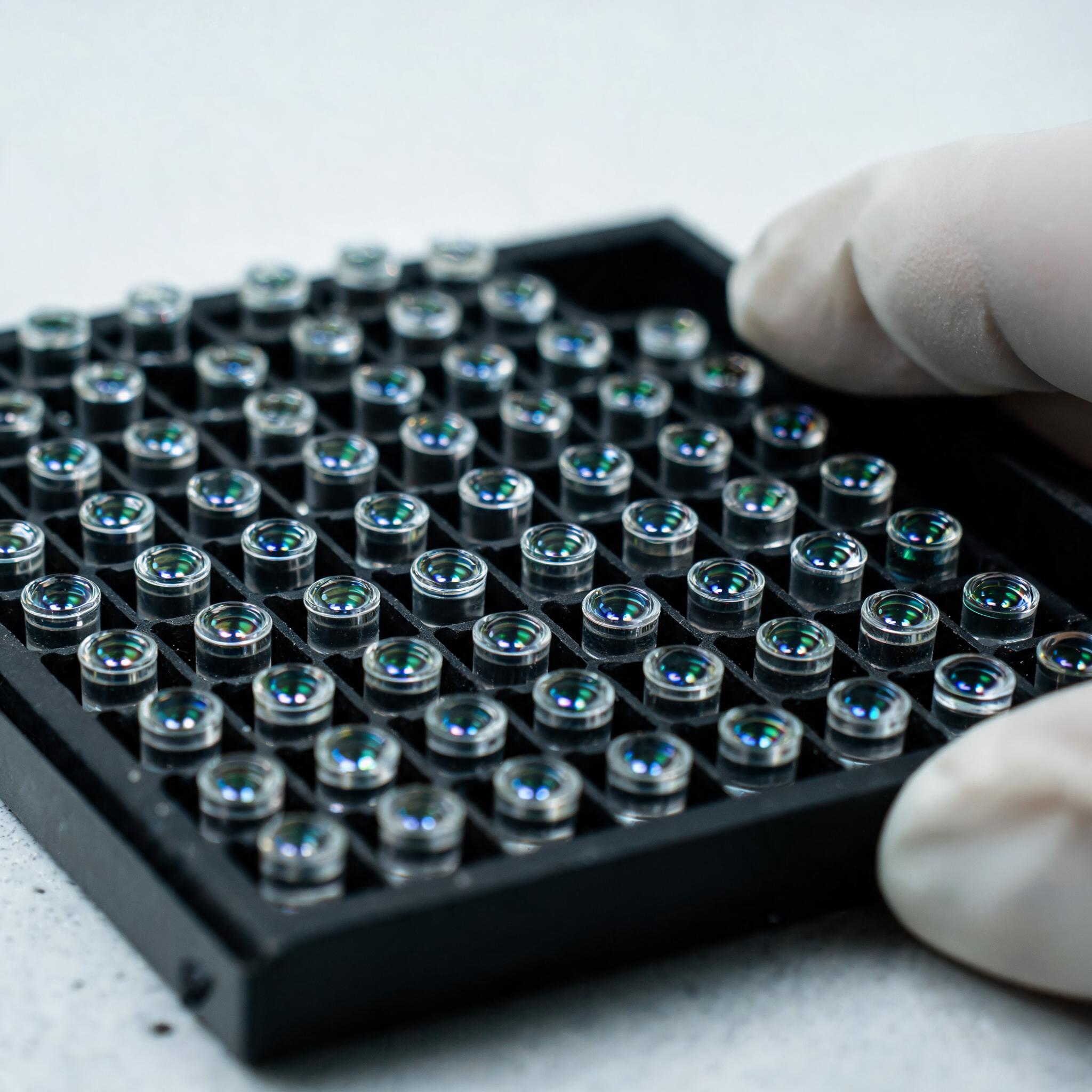
Yutong Optics says it has moved array-molding C-lens production from process validation to a ten-million-units-per-month delivery capability. That is an unusual number for a component most buyers treat as a commodity — and it is one of the clearest signals yet that molded glass is taking volume away from ground and polished optics.
On 30 September 2026, Yutong Optics (宇瞳光学) disclosed on its official channel that it has introduced array-molding into C-lens manufacturing, walked the full path from process validation to ten-million-units-per-month output, and entered regular volume shipping.
The supporting numbers are what make the announcement concrete. The company says it operates more than 600 precision molding machines paired with over 30 imported automatic coating machines, which together hold coating uniformity and part-to-part consistency. First-pass yield is stated as stable at above 85%. On C-lens specifically, the high-precision molding process has been validated by leading optical module customers and converted into batch orders.
Why a C-lens matters more than its price suggests
A C-lens is a cylindrical collimating lens, usually made from a high-index glass rod with spherical end faces. It sits inside optical modules and passive components to collimate a beam between a fiber and free-space optics. Individually it is one of the cheapest parts in the module. Collectively it is one of the most repeated: a single dense optical platform can contain dozens of them.
That combination — low unit price, high multiplicity — is exactly where manufacturing method decides who wins. Grinding and polishing one cylindrical lens at a time is slow and geometry-limited. Molding an array of them in a single pressing cycle changes the cost curve, but it forces the supplier to control mold wear, glass gob mass, thermal profile and coating adhesion across hundreds of cavities at once.
An 85%-plus first-pass yield on a ten-million-piece monthly line is the part of this announcement that deserves attention. Molding yield is where most attempts at volume glass optics stall.
Precision Optical Components & Lens Assemblies →
The mold platform is the real asset
Yutong states that its array-molding technology is highly extensible and will be systematically applied to A-lens (aspherical) and G-lens (gradient-index) components. Read plainly: the company is not selling a C-lens line, it is selling a reusable molded-glass platform that can be pointed at adjacent high-value components.
That matters for buyers because it changes how a second-source conversation should be framed. A supplier that has already qualified a molding platform has a shorter path to a new part than a supplier starting from a new process. The right question is not “can you make this lens?” but “which parts already run on your qualified array-molding platform, and what does adding mine cost in mold lead time?”
What to specify when you quote molded coupling optics
- Quote the molded blank and the coated part separately. Molding and coating are different cost and yield centres; bundling them hides where your price is actually coming from.
- Put first-pass yield in the contract. Ask for the yield band and the sampling plan behind it, not a single headline figure. Yield is the parameter that determines whether a ten-million-per-month line stays ten million.
- Define coating by performance, not by name. Reflectance at the working wavelength, adhesion after abrasion and environmental testing, and coating uniformity across a full tray belong in the specification.
- Freeze the critical geometry early. Mold lead time, not molding cycle time, is usually the schedule risk on a new C-lens or aspheric program.
- Check the second-source plan against the same platform. A backup supplier running the same molding family shortens requalification; a supplier running a different process is a new project.
This is a manufacturing shift, not a market spike
The move is part of a broader re-tooling of optical component capacity: lens makers that built their business on security-camera optics are converting molding and coating capacity into telecom and data-centre components. For optical module builders, the practical consequence is that molded coupling optics are becoming a volume, specifiable commodity rather than a scarce specialty. For anyone still buying ground-and-polished equivalents at ground-and-polished lead times, the next quotation round is worth re-opening.
Sourcing C-lens, aspheric or coupling optics?
Send your drawing, material grade, coating requirement, annual quantity and target delivery window to sales@tuolango.com and we will return a sourcing comparison with qualified suppliers and mold lead times.
Sources and disclosure
Sources: OFweek Optics report of 30 September 2026 on Yutong Optics’ disclosure — array-molding C-lens manufacturing taken from process validation to ten-million-units-per-month delivery; more than 600 precision molding machines and over 30 imported automatic coating machines; first-pass yield stated as stable above 85%; C-lens process validated by leading optical module customers with batch orders placed; stated plan to extend the array-molding platform to A-lens and G-lens components. Yield, qualification and procurement observations are TUOLAN TRADE analysis and are not attributed to any cited source. Edited and analysed by TUOLAN TRADE.