
Insights
1.6T Optical Transceivers: ZR/ZR+ Guide
INDUSTRY NEWS · OPTICAL TRANSCEIVERS · SEPTEMBER 2026
1.6T optical transceivers are crossing from exhibition demos into commercial deployment. Two signals this month — a new coherent pluggable family and trade-show demand data — tell buyers it is time to plan the 800G-to-1.6T migration.
1.6T optical transceivers are no longer a roadmap item. Within days this September, the industry’s first 1.6T ZR/ZR+ coherent pluggable family was announced for data center interconnect, and trade reporting from CIOE 2026 in Shenzhen pointed to commercial 1.6T shipments ramping in China. For network planners and sourcing teams, the question has shifted from “if” to “how to qualify and buy.”
Marvell COLORZ 1600: the first 1.6T ZR/ZR+ coherent pluggable
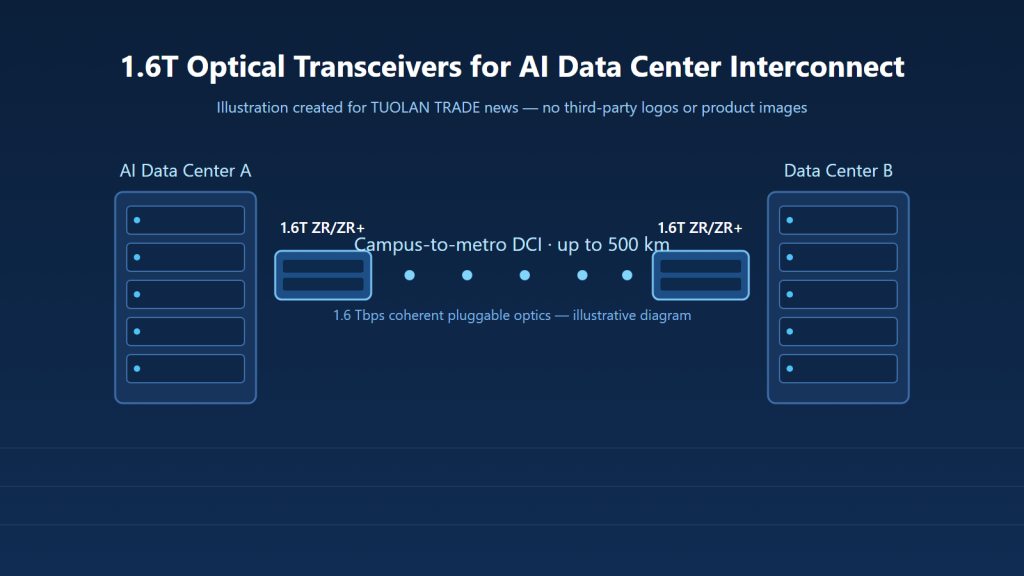
On September 14, 2026, Marvell introduced COLORZ 1600, described by the company as the industry’s first 1.6T ZR/ZR+ pluggable coherent module family. It targets campus-to-metro data center interconnect (DCI) at distances up to 500 km, is sampling with lead customers for evaluation, and is planned for volume production in the first quarter of 2027, with demonstrations scheduled at ECOC 2026 in Copenhagen (September 28 – October 1).
Coherent pluggables in the ZR/ZR+ class matter because they collapse what used to require dedicated transport shelves into a switch-faceplate module — changing both the bill of materials and the qualification process for metro DCI links.
CIOE 2026 signals: 1.6T demand forecasts climb
At CIOE 2026 (September 9–11, Shenzhen), Chinese trade media reported 1.6T modules moving into commercialization, citing hyperscale AI build-outs and pre-orders tied to next-generation switch platforms. One report citing LightCounting said China’s 2026 demand forecast for 1.6T modules was raised from 13 million to 22 million units. Treat these figures as directional trade-media signals rather than audited shipment data — but the direction is consistent across sources.
What 1.6T changes for DCI buyers
- Faceplate economics: doubling per-module capacity holds fiber count and switch slots flat as AI clusters scale east–west traffic.
- Reach tiers: ZR covers campus spans; ZR+ pushes toward metro distances (hundreds of kilometers), subject to line conditions.
- Technology mix: silicon photonics and LPO/LRO architectures are gaining share beside EML designs, changing cost and power per bit — and supplier scorecards.
- Test burden: 1.6T validation increasingly spans chip-to-system-to-datacenter flows; test vendors (for example EXFO’s new AI-infrastructure suites) are productizing exactly this.
Sourcing checklist for the 800G-to-1.6T migration
Based on how qualification cycles ran at 400G and 800G, teams evaluating 1.6T suppliers should lock down five items early:
- Switch compatibility lists and firmware interop records (not just MSA compliance statements)
- Thermal envelope and power draw per module at full line rate
- Second-source strategy across DSP and optics content
- Sample-to-mass-production lead times, in writing, with penalty terms
- Independent test evidence — ideally per-batch reports, not one-time golden-sample data
Sourcing optical transceivers from China?
TUOLAN TRADE helps overseas buyers qualify and source 100G/400G/800G production modules and early 1.6T evaluation units from vetted manufacturers, with factory-audit support. Send your target specs to sales@tuolango.com.
Sources and disclosure
All information in this article is compiled from public internet sources, including Marvell’s COLORZ 1600 announcement coverage (September 14, 2026) and Chinese trade-media reports from CIOE 2026. Market forecasts cited by trade media are directional and unaudited. TUOLAN TRADE is not affiliated with the companies mentioned; product names belong to their respective owners.