
Insights
Co-Packaged Optics: Open CPX 1.0 Explained
INDUSTRY NEWS · OPTICAL INTERCONNECT · SEPTEMBER 2026
Open CPX published a 78-page co-packaged optics connector specification before ECOC 2026, defining 6.4 Tbps and 7.2 Tbps sockets with published insertion-loss and impedance targets. Huawei then put 5,500 near-packaged optical engines into an Ascend 960 supernode in place of roughly 48,000 800G pluggables. Co-packaging has a socket standard and a production reference.
Co-packaged optics stopped being a vendor-specific idea in September 2026. The Open CPX multi-source agreement group published a 78-page specification for co-packaged and near-packaged connectors and optical modules ahead of ECOC 2026, defining two socket types with published electrical targets. Days earlier, at HUAWEI CONNECT 2026, Huawei described an Ascend 960 supernode that replaces roughly 48,000 800G pluggable optical modules with about 5,500 in-house near-packaged optical engines, cutting system power by more than 550 kW and quoting 99.8% system availability. One document defines the interface; the other demonstrates it at scale.
Open CPX 1.0: the socket standard
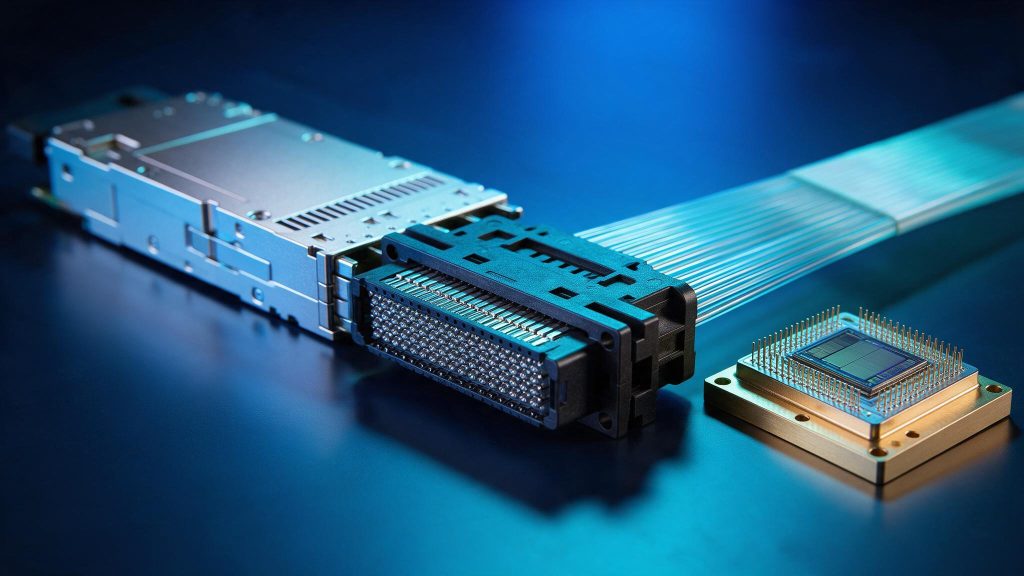
The Open CPX specification defines two socket architectures. Type-1 is a co-packaged socket with 200 pins, 32 channels and 6.4 Tbps of aggregate bandwidth. Type-2 is a near-packaged socket with 300 pins, 36 channels and 7.2 Tbps. The document also publishes performance targets including insertion loss at 53.125 GHz and 92.5 Ω differential impedance.
Those two electrical figures are the reason this matters more than a press release. A multi-source connector definition is what turns a single vendor’s architecture into something a second source can design against. Insertion loss and differential impedance are what let a system engineer budget the electrical channel, decide how much equalisation the DSP has to supply, and compare two suppliers’ connectors on the same terms. Without them, “CPO-ready” is a marketing claim; with them, it is a specification with a number attached.
Huawei’s near-packaged optics: the density argument
The Huawei disclosure is best read as an arithmetic exercise. About 5,500 Hi-ONE optical engines in place of roughly 48,000 800G pluggable modules works out to approximately nine 800G modules per optical engine if the reported figures are taken directly. That ratio is the entire argument for moving optics next to the switching ASIC: fewer packages, fewer electrical interfaces running across the front panel, and a power reduction quoted at more than 550 kW per system.
It also explains why the connector standard above is the piece that matters to buyers. Once the optics sit beside the ASIC, the pluggable front panel stops being the serviceable interface — so the socket becomes the replaceable boundary, and whoever defines the socket defines the supply chain. On 21 September Huawei also signed a strategic cooperation agreement with the Xi’an Institute of Optics and Precision Mechanics, naming “AI + optics” a core direction with priority access to compute resources and AI teams. Read as a pair, the two announcements describe a company treating photonic interconnect as a strategic dependency rather than a purchased component.
The supply chain forming behind it
- Thermal control. Bisheng Semiconductor moved into its own plant in April 2026 and added three production lines, taking micro thermoelectric cooler (Micro TEC) capacity to 1 million units per month. A second-phase class-10,000 cleanroom is due for completion in December 2026 to reach 2 million units per month, with a July 2027 target of 4 million units per month tied explicitly to CPO volume production. Micro TECs are what hold laser temperature — and therefore wavelength — stable, in co-packaged and pluggable modules alike.
- Detector speed. A 2024-founded III-V high-speed photodetector developer with a ShanghaiTech University background, funded by a tens-of-millions-of-yuan angel round, showed a 400G per wavelength MUTC-PD sample at CIOE 2026 aimed at 3.2T optical modules.
- Demand visibility. A mid-year 2026 optical communications industry report states that most firms have order capacity locked through the first half of 2028, with some locked to 2031 — while warning that cross-industry capital entering the sector could trigger price competition around 2028. The same report cites combined capital expenditure of USD 171.2 billion from North America’s four largest cloud providers in Q2 2026, up 130% year on year.
- Test capacity. At CIOE 2026, 1.6T modules were entering volume ramp while 3.2T remained in customer validation — yet test vendors were already showing solutions covering CPO and NPO from 1.6T and 3.2T through to 6.4T. Test is being built ahead of the products it will qualify.
Optical Transceivers & Interconnect →
What this means for transceiver and interconnect buyers
- Pluggables are not going away — but the interface is being redesigned. Plan for two procurement categories: the pluggable optics you buy today, and the near-packaged or co-packaged hardware that will arrive as part of a switch or accelerator platform.
- Type-1 and Type-2 are not interchangeable. Ask your platform vendor which socket their roadmap assumes before committing to a connector or module supplier.
- Thermal becomes a module-level specification. TEC capacity, ambient range and cold-plate interface move from the system integrator’s problem to a line item you can specify and test.
- Connectors and fiber arrays are now a distinct sourcing category. They need their own qualification, their own second source and their own lead-time management.
- Order visibility cuts both ways. Capacity booked to 2028 is a reason to secure allocation early — and a reason to write price-review clauses, given the sector’s own warning about competition resurfacing around 2028.
Interconnect sourcing checklist
- Confirm whether the platform roadmap assumes Type-1 co-packaged or Type-2 near-packaged optics, and at what channel count.
- For connectors and fiber arrays, request insertion loss and differential impedance data at the specified frequency, plus mating-cycle durability.
- Specify the thermal envelope explicitly: TEC capacity, operating ambient range, and the mechanical cold-plate interface.
- Ask for a second-source plan for every co-packaged component; a single-source socket is a schedule risk, not just a cost risk.
- Validate the test plan early — 1.6T and 3.2T test capacity is being installed now and is not uniformly available across suppliers.
- For 800G and 1.6T pluggables bought today, confirm how the module’s thermal and mechanical design will behave in a chassis designed for future co-packaging.
- Ask suppliers to state what is shipping versus what is announced. Samples, customer validation and volume production are three different commitments.
Sourcing optical transceivers and interconnect from China?
TUOLAN TRADE helps overseas buyers specify optical interconnect by rate, reach and thermal envelope, distinguish shipping products from roadmap announcements, and coordinate samples, test evidence and export delivery. Send your requirement to sales@tuolango.com.
Sources and disclosure
Figures are compiled from public internet sources dated September 2026: Chinese optical-communications trade media reporting on the Open CPX specification 1.0 release, Huawei’s Ascend 960 near-packaged optics disclosure and its strategic cooperation agreement with the Xi’an Institute of Optics and Precision Mechanics, Bisheng Semiconductor’s Micro TEC capacity plan, and a CIOE 2026 detector announcement; plus a published mid-year 2026 optical communications industry report citing cloud capital expenditure. Connector dimensions, impedance and loss targets, capacity figures and power savings are the reporting organisations’ or companies’ published statements; the nine-modules-per-engine ratio is our arithmetic on those published figures, not a vendor claim. Announced and planned capacity is not installed capacity. Sourcing guidance in this article is editorial analysis. TUOLAN TRADE is not affiliated with the companies mentioned; company and product names belong to their respective owners.