
Product forms
Common configurations
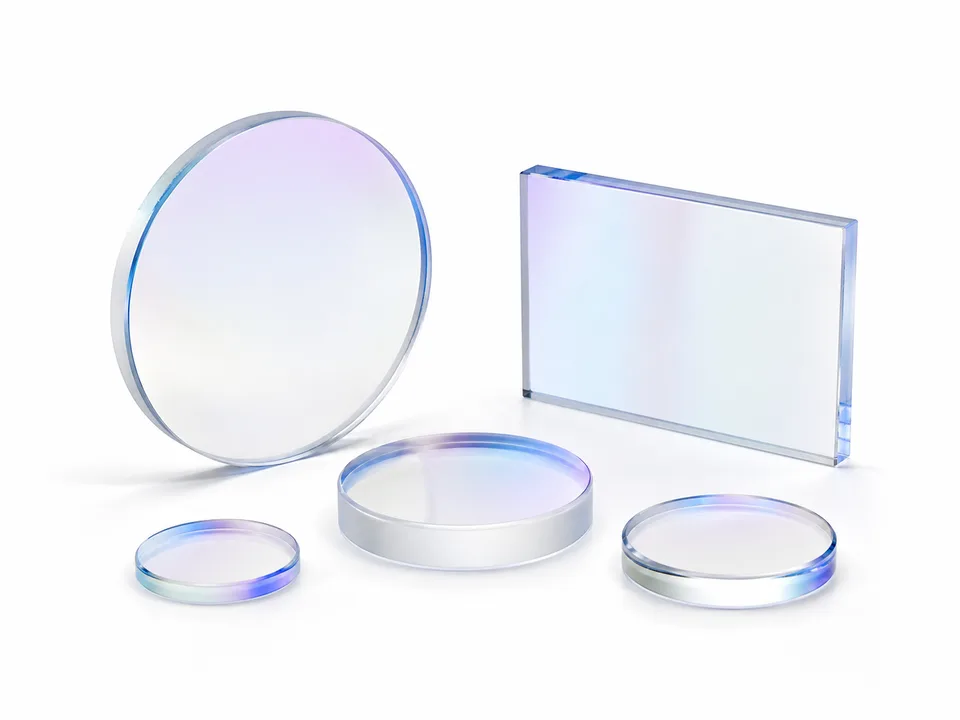
- Round and rectangular windows
- Brewster and wedged windows
- Protective sensor windows
- UV, visible and infrared windows
Build-to-print precision optics
Optical windows protect sensors, lasers and imaging systems while preserving transmission and wavefront quality. We review the substrate, spectral band, aperture, surface quality, flatness, parallelism, edge geometry and environmental load as one specification.
Product forms
Materials & wavelength
Optical glass, fused silica, sapphire, CaF₂, BaF₂, silicon, germanium and ZnSe, subject to wavelength and environment.
UV, visible, VIS–NIR, MWIR and LWIR routes are reviewed by substrate and coating.
End use
Engineering discussion framework
These values show the type of requirement that can be evaluated. They are not a blanket capability guarantee. The signed quotation, approved drawing, sample and inspection plan control the final product.
| Parameter | Reference target / quotation note |
|---|---|
| Size route | Reference RFQ target: Ø0.5–600 mm; rectangular parts up to 1000 × 600 mm. Large formats require separate process review. |
| Clear aperture | Central 90% is a common target; drawing-controlled apertures are also reviewed. |
| Surface flatness | Targets down to PV λ/40 at 632.8 nm may be evaluated according to material, size and test aperture. |
| Surface quality | 10-5 scratch-dig target can be evaluated; commercial grades are available for cost-sensitive projects. |
| Parallelism / wedge | Parallelism below 3 arcsec or a controlled wedge angle may be specified. |
| Coating | Uncoated, single-band AR, BBAR, high-reflection or project-specific spectral designs. |
Faster technical review
Attach drawings or spectra where possible. Factory visits and supplier audits are available by appointment for qualified projects after the route is confirmed.
Technical selection guide
Prepare substrate, wavelength, clear-aperture, flatness, surface-quality, parallelism, coating and inspection inputs for a comparable optical-window quotation.
The guide links the optical application to the drawing, acceptance data and information needed for a comparable quotation.
Buyer questions
Start with wavelength, transmission, thermal environment, mechanical load and budget. Fused silica is common for UV-to-NIR work, while crystalline and semiconductor materials are reviewed for infrared bands.
It can. Flatness, wedge, transmitted wavefront, coating, thickness and installation angle may influence focus, ghosting and aberration. Include the system geometry in the RFQ.
Yes. Rectangular, square and other drawing-defined shapes can be reviewed. Size, aspect ratio, material, flatness and edge support determine the practical route.
Related precision optics
Send the drawing, material, wavelength, tolerances, coating, quantity and target date.