
Product forms
Common configurations
- Plano-convex cylindrical lenses
- Plano-concave cylindrical lenses
- Bi-convex and bi-concave cylinders
- Acylindrical and custom rectangular lenses
Build-to-print precision optics
A cylindrical lens has optical power in one axis and little or no power in the orthogonal axis. It is used to form a line, reshape a laser beam, correct astigmatism or focus one dimension of an image independently.
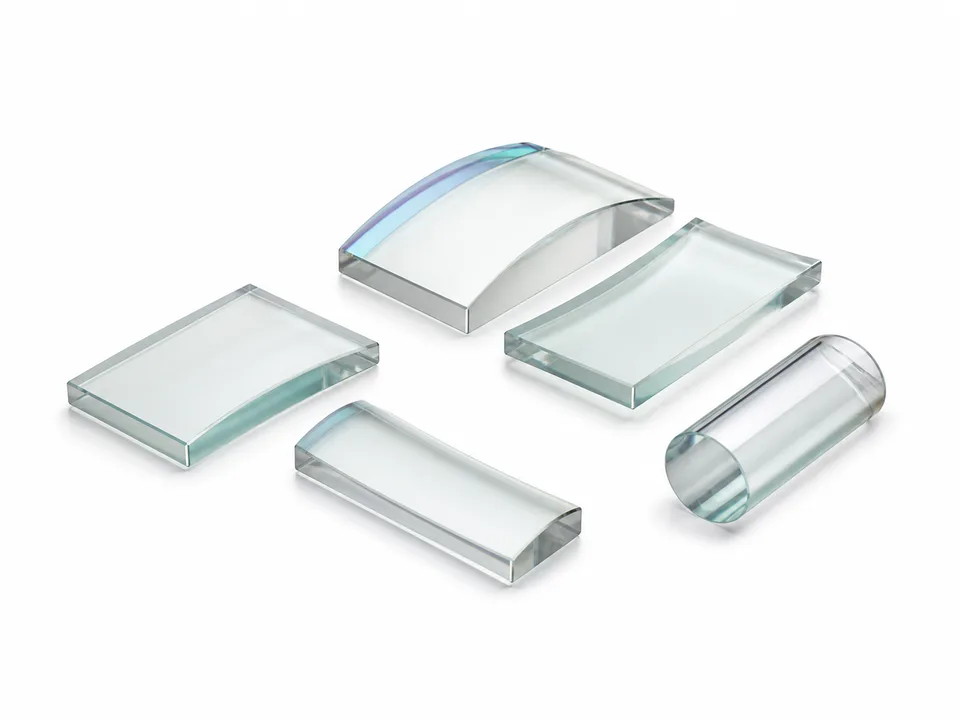
Product forms
Materials & wavelength
BK7-class optical glass, fused silica and selected UV-to-IR materials according to wavelength and damage requirements.
UV, visible and NIR are common; infrared routes are reviewed by material, aperture and coating.
End use
Engineering discussion framework
These values show the type of requirement that can be evaluated. They are not a blanket capability guarantee. The signed quotation, approved drawing, sample and inspection plan control the final product.
| Parameter | Reference target / quotation note |
|---|---|
| Size route | Reference RFQ range: approximately 2–500 mm; rectangular clear apertures and aspect ratios are drawing-controlled. |
| Clear aperture | Central 90% is a common target. |
| Surface irregularity | Targets to λ/10 at 632.8 nm may be evaluated, with powered and non-powered axes specified separately. |
| Surface quality | 10-5 scratch-dig target can be evaluated; 40-20 is a common precision-commercial request. |
| Centration / axis | Below 1 arcmin may be specified; cylinder-axis orientation and wedge need drawing datums. |
| Focal-length tolerance | ±2% is a common reference target; tighter values require geometry and index review. |
Faster technical review
Attach drawings or spectra where possible. Factory visits and supplier audits are available by appointment for qualified projects after the route is confirmed.
Technical selection guide
Review powered-axis orientation, focal length, line geometry, anamorphic pairs, coatings and inspection inputs for a cylindrical-lens RFQ.
The guide links the optical application to the drawing, acceptance data and information needed for a comparable quotation.
Buyer questions
A spherical lens has optical power in two axes. A cylindrical lens focuses or expands mainly in one axis, which enables line generation and anamorphic correction.
Mark the powered and non-powered axes, optical clear aperture and mechanical datums on the drawing. Include the permitted axis-orientation error.
Yes. Provide the input beam, target beam size or line length, spacing, wavelength and allowable wavefront error so the pair can be reviewed as a system.
Related precision optics
Send the drawing, material, wavelength, tolerances, coating, quantity and target date.