
Product forms
Common configurations
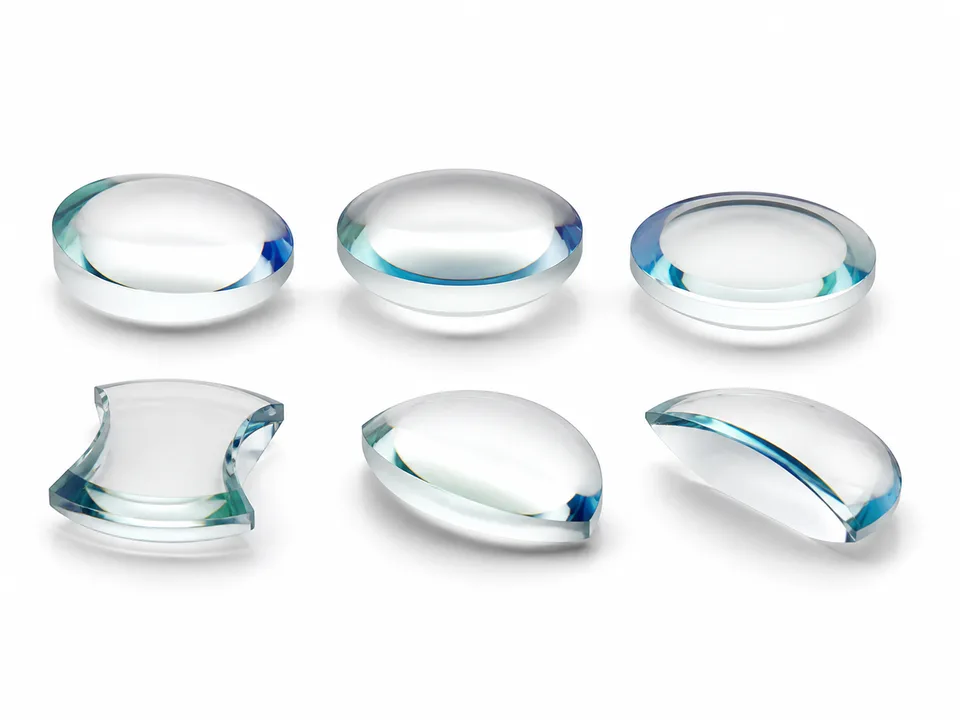
- Plano-convex and bi-convex lenses
- Plano-concave and bi-concave lenses
- Positive and negative meniscus lenses
- Achromatic doublets and custom cemented groups
Build-to-print precision optics
Spherical lenses are the most widely used focusing, collimating and imaging elements. The correct form depends on conjugate ratio, focal length, aperture, aberration budget, material, wavelength and how the lens is mounted.
Product forms
Materials & wavelength
Optical glass, fused silica, CaF₂, MgF₂, sapphire, silicon, germanium and ZnSe, subject to the working band.
UV, visible, VIS–NIR, MWIR and LWIR routes are evaluated by material, radius and coating.
End use
Lens configuration guide
A plano-convex lens has one flat surface and one convex spherical surface. It is a common starting point for focusing a collimated beam or collimating light from a source. The choice depends on wavelength, source size, beam diameter, conjugates and image-quality requirements.
For an RFQ, distinguish effective focal length (EFL) from back focal length (BFL). State both where the optical design or mounting envelope requires them, and identify the reference wavelength and measurement surfaces. Include diameter, clear aperture, center thickness, edge details, surface radii or a controlled drawing, and dimensional tolerances.
Material and coating must match the application. Optical glass, fused silica or a suitable infrared substrate should be reviewed against the operating band, transmission, temperature and power conditions. Specify anti-reflection performance across the required band, angle of incidence and polarization.
Finally, state whether the lens is used for focusing or collimation, its orientation and available mounting space. Share the target spot size or collimated-beam requirement, quantity and inspection documents. We use these inputs to review the sourcing route; the approved quotation and drawing define the deliverable.
Technical background: optical lens geometries and focal-length terminology.
Engineering discussion framework
These values show the type of requirement that can be evaluated. They are not a blanket capability guarantee. The signed quotation, approved drawing, sample and inspection plan control the final product.
| Parameter | Reference target / quotation note |
|---|---|
| Diameter route | Reference RFQ range: approximately 1–500 mm, subject to material, radius, center thickness and test aperture. |
| Clear aperture | Central 90% is a common target. |
| Surface irregularity | Targets to λ/20 at 632.8 nm may be evaluated for suitable geometries and apertures. |
| Surface quality | 10-5 scratch-dig target can be evaluated; other grades are quoted by application. |
| Centration | Below 1 arcmin may be specified, with tighter decenter/runout controlled by drawing and metrology. |
| Coating | AR, BBAR, laser-line, high-reflection or custom spectral design. |
Faster technical review
Attach drawings or spectra where possible. Factory visits and supplier audits are available by appointment for qualified projects after the route is confirmed.
Buyer questions
For build-to-print work, provide the complete radii and thickness. For an optical-design request, provide effective focal length, conjugates, aperture, wavelength and performance target.
A correctly oriented meniscus can help control spherical aberration and package geometry. The optimum form depends on conjugates and the surrounding optical system.
Yes. Wavelengths, focal length, aperture, glass availability, cement or air gap, temperature and mounting requirements should be defined.
Related precision optics
Send the drawing, material, wavelength, tolerances, coating, quantity and target date.