
Product forms
Common configurations
- Right-angle, penta and Porro prisms
- Dove, roof and retroreflector prisms
- Equilateral and Pellin–Broca dispersive prisms
- Anamorphic prism pairs and custom shapes
Build-to-print precision optics
Optical prisms turn, invert, rotate, disperse or reshape an optical path. A useful prism drawing defines face angles, datum surfaces, roof or edge geometry, clear apertures, coatings and the relationship between optical and mechanical datums.
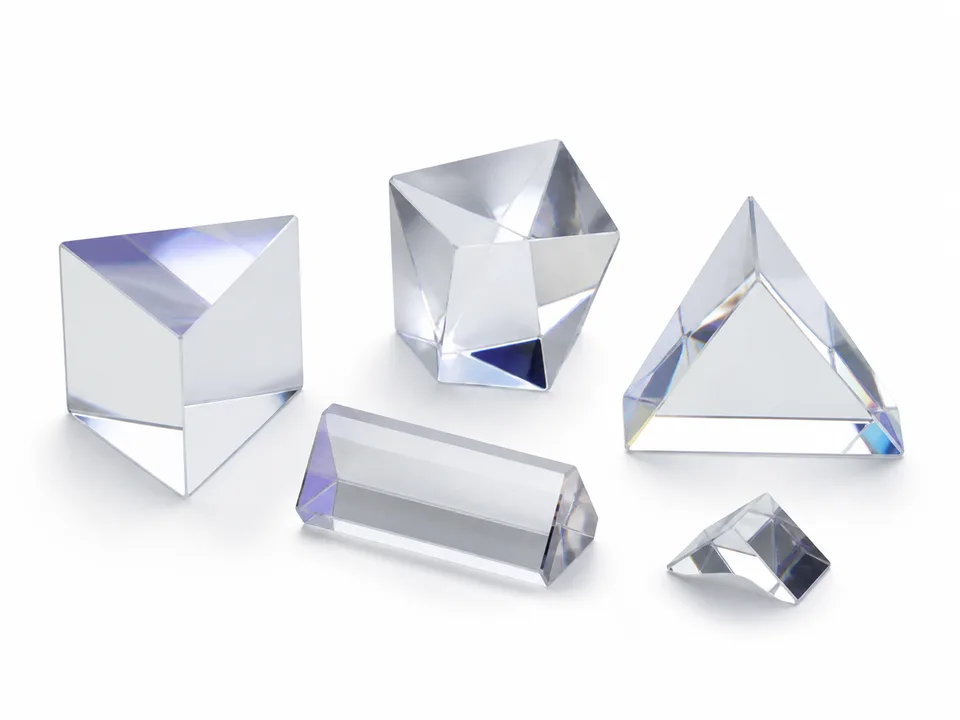
Product forms
Materials & wavelength
Optical glass, fused silica, CaF₂ and other UV-to-IR materials selected for dispersion, transmission and environment.
UV through infrared, with material and coating selected for the operating band.
End use
Prism selection
Start with the required beam direction and image orientation, then mark the entrance, exit and reflecting faces on the drawing. Prism names identify a starting geometry; the ray path, mounting and acceptance criteria define the component.
Consider this form for beam turning or folding an optical path. Identify the working faces and required image orientation, then specify material, clear aperture, face angles and which surfaces need coatings.
Consider a Dove prism when image rotation is part of the system task. Include the beam geometry, prism orientation, usable aperture and mounting datums so image behavior can be reviewed with the optical layout.
Consider a penta prism when defining a right-angle beam path. Specify the required beam deviation, reflecting faces, coating assignments and mechanical reference surfaces, together with the permitted angular error.
For a custom optical prism RFQ, attach the ray-path sketch and dimensioned drawing, wavelength, face flatness, surface quality, angular tolerances, quantity and inspection requirements. The approved drawing and quotation define the final configuration.
Technical background: optical prism application examples and penta-prism geometry.
Engineering discussion framework
These values show the type of requirement that can be evaluated. They are not a blanket capability guarantee. The signed quotation, approved drawing, sample and inspection plan control the final product.
| Parameter | Reference target / quotation note |
|---|---|
| Size route | Reference RFQ range: approximately 0.5–100 mm, with custom geometry reviewed by drawing. |
| Clear aperture | Central 90% is a common target; usable face area should be marked on the drawing. |
| Face flatness | Targets to λ/10 at 632.8 nm can be evaluated. |
| Surface quality | 10-5 scratch-dig target can be evaluated for low-scatter applications. |
| Angular tolerance | Targets below 15 arcsec may be evaluated according to prism type and datum scheme. |
| Coating | AR, reflective, beamsplitter or total-internal-reflection face definitions by surface. |
Faster technical review
Attach drawings or spectra where possible. Factory visits and supplier audits are available by appointment for qualified projects after the route is confirmed.
Buyer questions
Identify optical faces, face angles, datums, clear apertures, edge or roof tolerances, material and coating. A marked drawing is safer than a prism name alone.
Yes, when material index, wavelength and incidence geometry support it. External reflective coatings may still be selected for environmental or angular reasons.
Bonded, contacted or mechanically mounted prism assemblies can be reviewed when the alignment, adhesive, environment and acceptance test are defined.
Related precision optics
Send the drawing, material, wavelength, tolerances, coating, quantity and target date.