
Product forms
Common configurations
- Laser-line dielectric mirrors
- Broadband dielectric mirrors
- Protected silver, aluminum and gold mirrors
- Partial reflectors and beam-splitting mirrors
Build-to-print precision optics
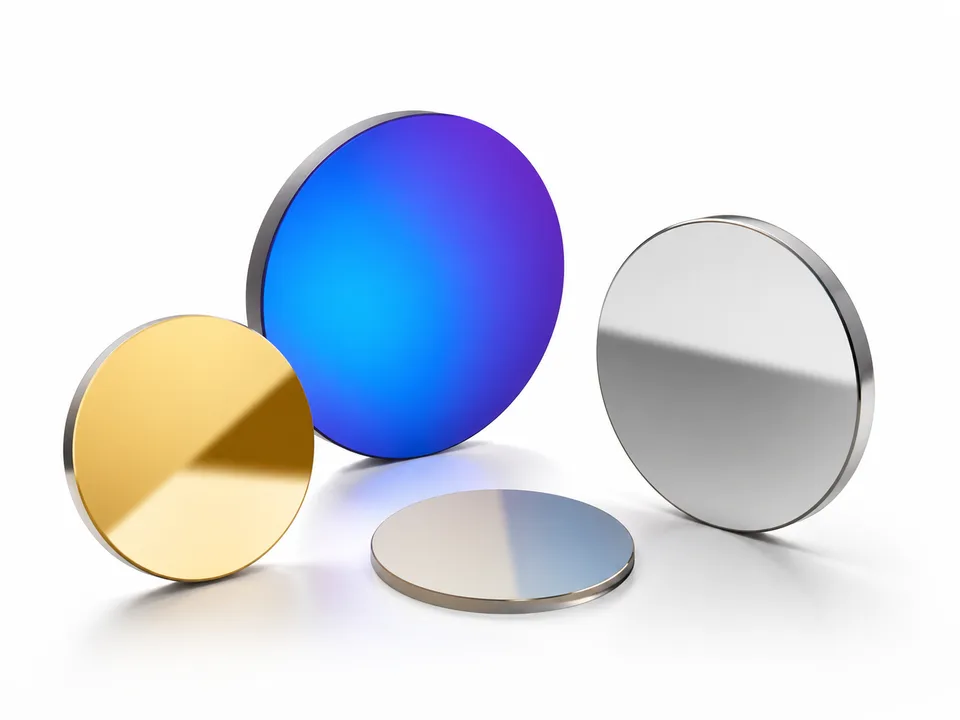
Optical mirrors redirect, fold or split a beam without transmitting it through the full substrate. Mirror design starts with wavelength, angle of incidence, polarization, reflectivity, surface figure, environmental durability and laser-energy conditions.
Product forms
Materials & wavelength
Fused silica, low-expansion glass, optical glass, silicon and other project-selected substrates.
UV, visible, NIR and infrared reflection bands, including narrow laser-line and broadband designs.
End use
Engineering discussion framework
These values show the type of requirement that can be evaluated. They are not a blanket capability guarantee. The signed quotation, approved drawing, sample and inspection plan control the final product.
| Parameter | Reference target / quotation note |
|---|---|
| Diameter / envelope | Reference RFQ range: approximately 0.5–500 mm, subject to substrate, thickness and test aperture. |
| Clear aperture | Central 90% is a common target. |
| Surface flatness | Targets to λ/10 at 632.8 nm can be evaluated; tighter requirements need aperture and mounting review. |
| Surface quality | 10-5 scratch-dig target can be evaluated where scattering control is critical. |
| Parallelism | Below 3 arcmin may be specified when the rear surface is functionally relevant. |
| Reflective coating | High reflector, partial reflector, broadband dielectric or protected metallic coating by band, AOI and polarization. |
Faster technical review
Attach drawings or spectra where possible. Factory visits and supplier audits are available by appointment for qualified projects after the route is confirmed.
Buyer questions
Dielectric designs can deliver high reflectivity in a defined band and angle range. Metallic mirrors are often selected for broader spectral coverage. Polarization, durability and cost also matter.
A coating spectrum shifts with incidence angle and can differ for s- and p-polarization. Both inputs are necessary for a meaningful coating design.
Yes. Provide wavelength, pulse duration, repetition rate, beam diameter, fluence or CW power density, and the requested test standard.
Related precision optics
Send the drawing, material, wavelength, tolerances, coating, quantity and target date.