
Product forms
Common configurations
- Plano-aspheric and bi-aspheric lenses
- Acylindrical and hyperbolic surfaces
- Axicons and conical optics
- Freeform and drawing-defined surfaces
Build-to-print precision optics
Aspherical surfaces add design freedom beyond a simple sphere. They can reduce spherical aberration, replace multiple spherical elements, improve edge performance or create a controlled non-conventional beam profile.
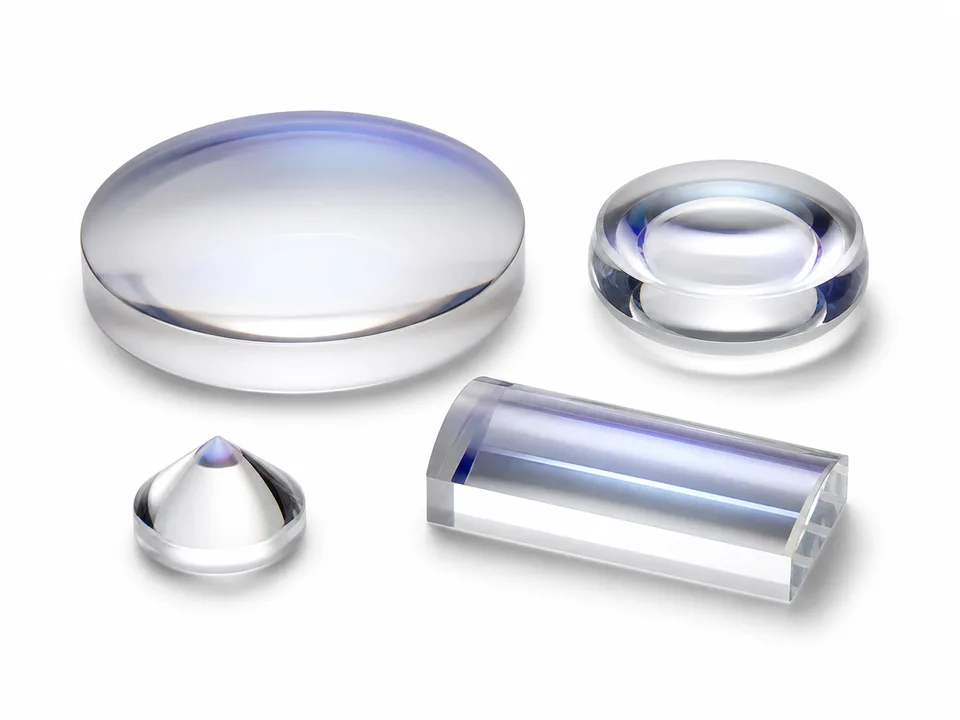
Product forms
Materials & wavelength
Optical glass, fused silica, crystalline materials and selected infrared substrates, subject to process route and metrology.
UV through infrared, with process, coating and testing matched to the selected substrate.
End use
Engineering discussion framework
These values show the type of requirement that can be evaluated. They are not a blanket capability guarantee. The signed quotation, approved drawing, sample and inspection plan control the final product.
| Parameter | Reference target / quotation note |
|---|---|
| Diameter route | Reference route: Ø5–200 mm for many CNC-polished designs; larger or unusual apertures require dedicated equipment and metrology review. |
| Clear aperture | Central 90% is a common target; slope near the edge must be considered. |
| Surface irregularity | Targets to λ/10 at 632.8 nm may be evaluated according to departure, slope and test method. |
| Surface quality | 10-5 scratch-dig target can be evaluated for appropriate materials and shapes. |
| Centration | Below 3 arcmin is a reference target; precision projects should specify datum and runout method. |
| Data definition | Even asphere, odd asphere, Q-type, sag table, point cloud or CAD surface, with sign convention stated. |
Faster technical review
Attach drawings or spectra where possible. Factory visits and supplier audits are available by appointment for qualified projects after the route is confirmed.
Technical selection guide
Compare aberration control, system size, surface definition, manufacturing route and metrology before specifying a custom asphere.
The guide links the optical application to the drawing, acceptance data and information needed for a comparable quotation.
Buyer questions
Its changing surface curvature provides extra aberration control. The actual element reduction depends on field, aperture, wavelength and manufacturing tolerances.
Provide the base radius, conic constant, polynomial coefficients and sign convention, plus aperture and thickness. A sag table or CAD model helps prevent interpretation errors.
The method may include interferometry with a null optic or CGH, profilometry, deflectometry or coordinate measurement. Define form, slope and roughness acceptance with the supplier.
Related precision optics
Send the drawing, material, wavelength, tolerances, coating, quantity and target date.