
Insights
Boston Dynamics Gives Atlas a Four-Finger, 13-DOF Hand for Tool Use
ROBOTICS · ACTUATION & TACTILE SENSING · OCTOBER 2026
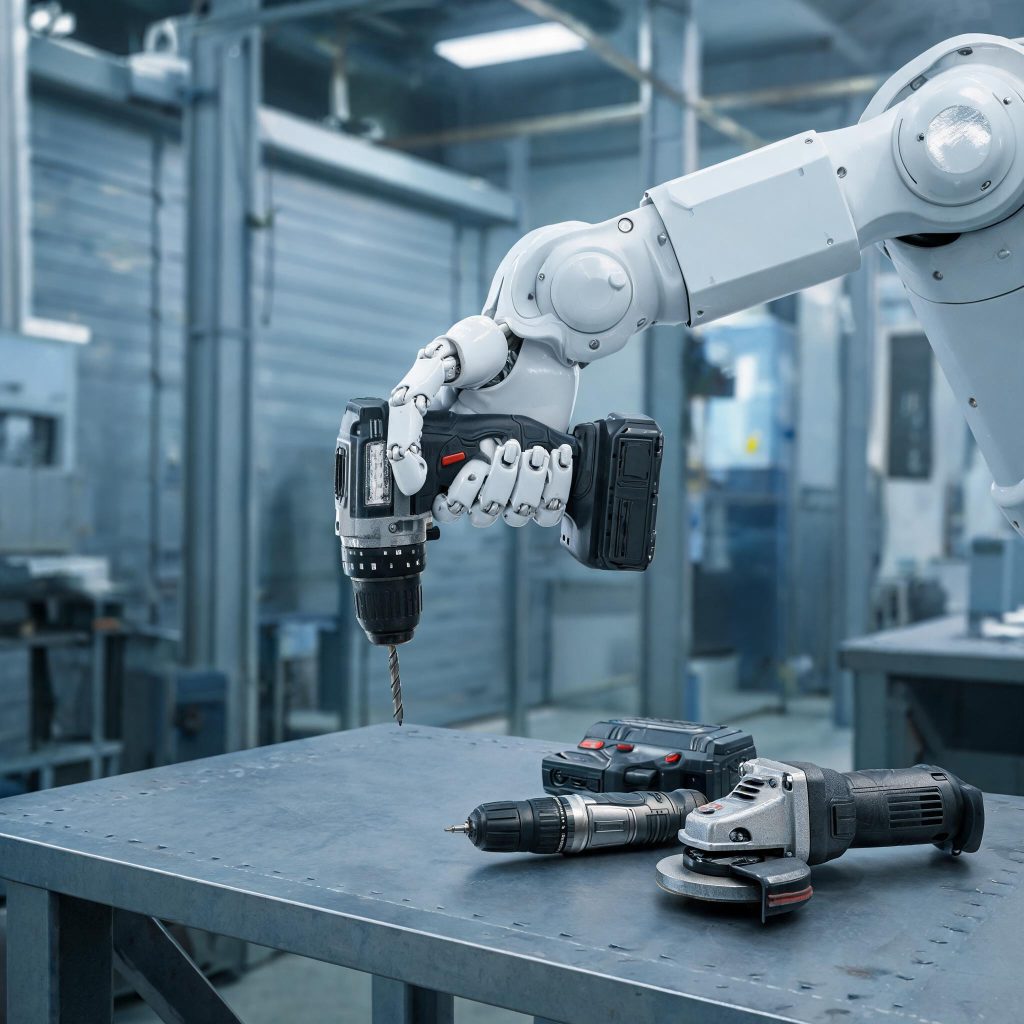
Boston Dynamics has given Atlas a new hand: four fingers, 13 degrees of freedom, a four-DOF opposable thumb, and dense tactile pressure sensing across fingertips and palm. The company deliberately deleted the pinky, and the reason matters more than the specification — adding a fifth finger would have meant three more actuators, more volume and more failure points.
The design was published on 2 October 2026 by Robotics & Automation News. Boston Dynamics describes the hand as combining the dexterity needed for complex manipulation and tool use with the strength and durability required for industrial work, and lists the tasks it is built for: in-hand object reorientation, pinch and tripodal grasps, recovery from slipping objects, and operation of tools including drills, power torque drivers, grinders, nail guns and welding torches.
The architecture is deliberately different from the previous generation. Atlas’ earlier seven-DOF hands were designed primarily to grasp a wide range of objects. The new hand is designed to manipulate them. Each of the three fingers carries three degrees of freedom; the opposable thumb carries four and can slide along both the length and width of the other fingers, which is what allows different pinch and tool-holding configurations.
The pinky test
Boston Dynamics did not omit the fifth finger for aesthetics. According to the company, chief technology officer Zack Jackowski asked team members to tape their pinky and ring fingers together for a day and report which tasks they could no longer perform. The experiment convinced the development team that four fingers were sufficient for the capabilities being targeted. Adding another finger would require three additional actuators, increasing the hand’s cost, volume and the number of potential failure points.
The result is a hand approximately the size of a large human hand — a deliberate choice, because Atlas is intended to operate in environments, spaces and workstations originally designed for people. Despite the higher dexterity, the company says the new hand maintains similar strength to the previous design, having previously demonstrated Atlas carrying a loaded mini-fridge weighing more than 100 lb.
Camera & Robot Hardware Sourcing →
Manufacturability is now a stated design goal
The sentence that should interest anyone in the supply chain is not about dexterity. Boston Dynamics says the actuators are encapsulated, use a single actuator type, and have no cables crossing the joints, and that this architecture is intended to improve ruggedness, manufacturability and repairability as humanoid robots move toward larger-scale production.
Read that as a component strategy. The previous seven-DOF hand was a low-volume engineering artefact. A 13-DOF hand built from one actuator type, with encapsulated units that can be swapped as complete assemblies, is a design meant to be assembled and repaired at volume. It reduces the SKU count a robot maker has to qualify, and it moves value toward the actuator module, the tactile sensor array and the sealed connector rather than toward bespoke joint wiring.
Tactile sensing sits alongside proprioception
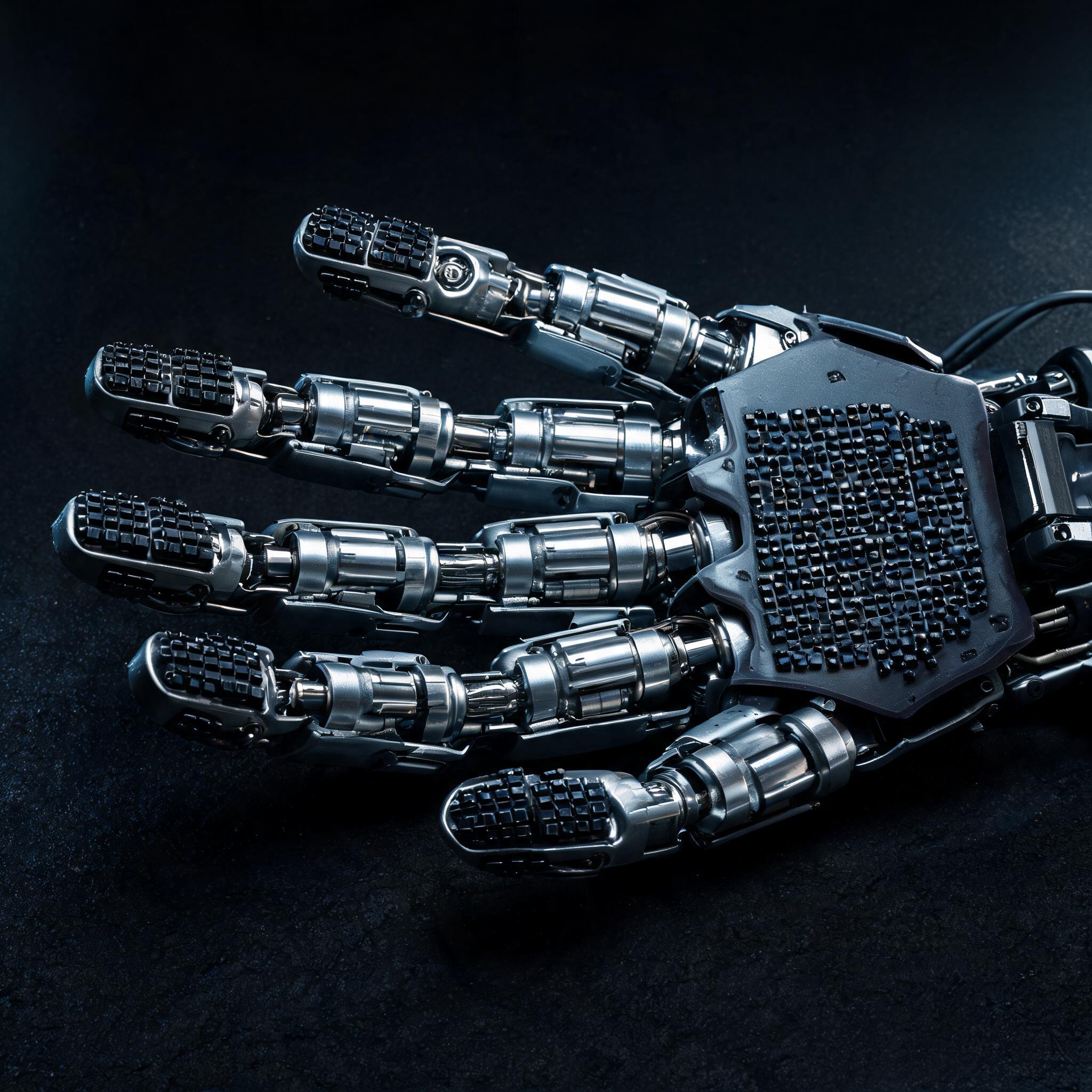
The hand uses dense pressure tactile sensors covering the fingertips and the palm, complementing the proprioceptive sensing provided through the actuators. Boston Dynamics says this lets Atlas detect small contact signals while interacting with objects and supplies the feedback needed for more delicate manipulation, with backdrivability and actuator transparency central to the design because they let the robot use proprioception for agile manipulation and force regulation.
Tool use is framed as capability extension rather than a fallback. The company argues that rather than trying to build a hand that performs every task directly, tools extend humanoid capability in the same way they extend human capability — and that this becomes increasingly important as humanoids move beyond conventional pick-and-place into assembly, cables, tools and objects presented in less structured environments.
Designed for simulation and reinforcement learning
The hand was designed with simulation in mind as well. Boston Dynamics says its rigid-drive actuation, backdrivable transmission and control systems let the physical behaviour of the hand be reproduced with high fidelity in simulation, so reinforcement learning systems can train manipulation policies while varying motor torque, surface friction, object geometry and disturbances before transferring them to hardware.
The company reports initial sim-to-real results in dynamic manipulation, with behaviours trained entirely in simulation and then deployed on Atlas using high-rate actuator proprioception for feedback. It frames reinforcement learning as a complement to human demonstration data: demonstrations show how objects are manipulated, while simulated RL trains the high-speed control and force regulation needed to execute those movements reliably.
What this changes for robot component sourcing
- Actuator count is the cost driver, and designers are now trading fingers against it. Three actuators per finger is the number that killed the pinky. Expect more designs that specify the minimum finger count that meets the task list rather than matching human anatomy.
- Standardising on one actuator type is a sourcing advantage. A single sealed actuator module qualified across the whole hand collapses the bill of materials and the spares list. Suppliers who can hold tolerances across a family, not a single part number, are better positioned than one-off machinists.
- No cables across joints means connectors and sealed assemblies carry the value. If the joint is a self-contained encapsulated unit, the reliability question moves to the feed-through, the seal and the module-level test. Those are the processes to qualify.
- Tactile arrays are now a second sensing procurement line. Fingertip and palm pressure sensing is specified with density, not just presence. Sensor count, spatial resolution, hysteresis and drift under repeated load are the parameters to request.
- Ask whether the part is simulation-modelled. Backdrivability and actuator transparency are being specified because they make the hardware reproducible in simulation. A supplier who can provide validated actuator models and consistent unit-to-unit behaviour is worth more than one who only quotes a torque figure.
Sourcing actuators, tactile sensors or robot sub-assemblies?
Send your degrees of freedom per joint, torque and speed envelope, tactile sensing requirement, annual volume and qualification standard to sales@tuolango.com and we will return a qualified supplier shortlist with lead times.
Sources and disclosure
Sources: Robotics & Automation News, 2 October 2026, by Sam Francis, on the Boston Dynamics Atlas four-finger hand (13 degrees of freedom, four-DOF opposable thumb, three degrees of freedom per finger, direct actuation, dense tactile pressure sensors on fingertips and palm, single encapsulated actuator type with no cables crossing the joints, backdrivability and actuator transparency, in-hand reorientation and slip recovery, tool use including drills, power torque drivers, grinders, nail guns and welding torches, approximately large-human-hand size, similar strength to the previous design and the previously demonstrated loaded mini-fridge above 100 lb, the pinky-and-ring-finger taping experiment attributed to CTO Zack Jackowski, three additional actuators required per added finger, and the simulation and sim-to-real reinforcement learning programme). Procurement, qualification and supply-chain observations are TUOLAN TRADE analysis and are not attributed to any cited source. Edited and analysed by TUOLAN TRADE.