
Insights
CIOE 2026: Optics Suppliers Move to Systems
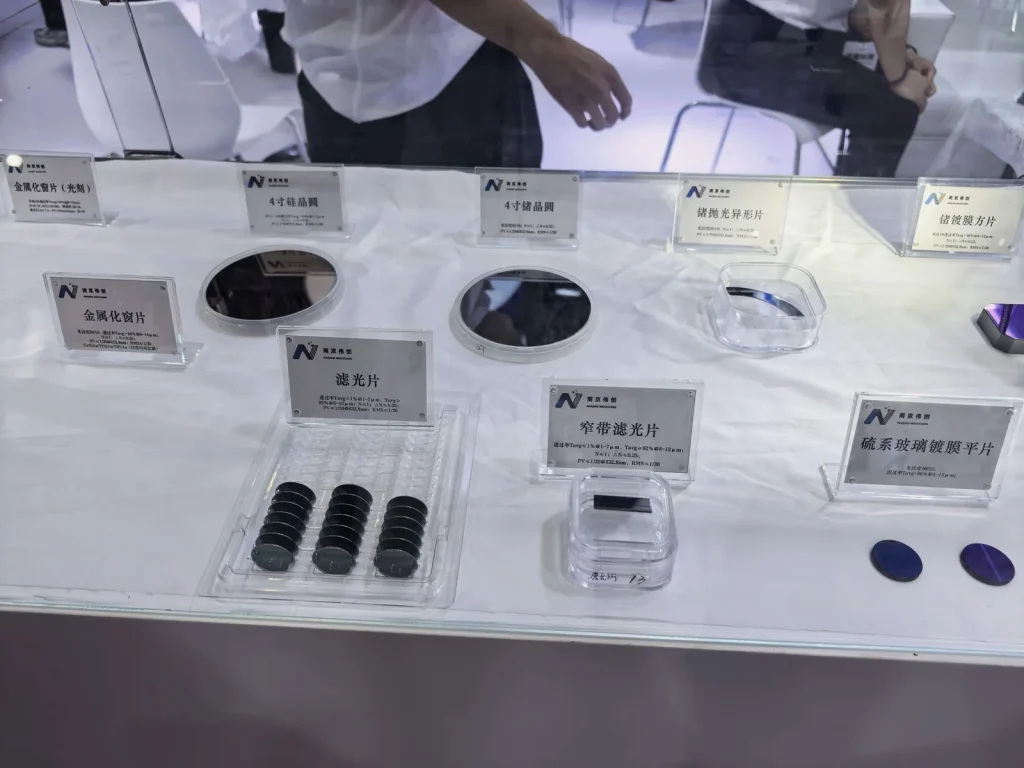
At CIOE 2026 in Shenzhen (9–11 September), the most consequential news for component buyers was not a new lens or a new window. It was three suppliers repositioning away from selling elements and towards selling integrated optical systems.
Three signals from the show floor
Sunny Optical (02382.HK) appeared under a new identity — “full-scenario, end-to-end, intelligent optical system provider” — and described a dual strategy of optics plus AI. The company says its element-to-module-to-system-to-algorithm delivery chain is already commercial: mower-robot and warehouse-automation robot vision projects are reported in mass production, with further machine and system projects awarded. In its interim results it disclosed XR revenue of RMB 956 million for the first half of 2026, up roughly 11% year on year, with thin full-colour AR display modules in small-batch production alongside global brand partners. Optical interconnect products are in domestic customer validation, with small-volume supply expected in 2027; optical computing and optical storage remain long-term reserves.
Crystal Optech (002273) showed a VHG volume-holographic single-piece multicolour waveguide publicly for the first time, alongside its existing GWG geometric and SRG surface-relief waveguide routes — three AR optics architectures under one roof.
Goertek Optics (002241) exhibited a family of full-colour waveguides covering etched, nano-imprint and DUV diffraction types, including an SiC full-colour waveguide module, plus Pancake modules and automotive optics.
A fourth, quieter signal came from Coherent, which extended its pluggable optical line system with a full-C-band high-power amplifier module now shipping at scale: integration is migrating out of the component and into the line system itself.
Why this matters when you buy elements
Component-level sourcing assumes the supplier will sell you an element and you will assemble the optical system around it. When the same suppliers start packaging element, module, system and algorithm together, that assumption weakens in three practical ways.
First, specifications get written at module level. A vendor optimising a module has less incentive to publish — or even to hold — an element specification that a third party can reproduce.
Second, prototype single-piece quoting becomes harder to secure. Element-level trade depends on suppliers who will take one-off drawings; systems vendors route their engineering capacity to programmes.
Third, your second-source options narrow silently. If the element drawing behind a module is never documented, re-sourcing that element later becomes a redesign rather than a re-order.
What to change in your RFQ
None of this argues against buying systems — it argues against buying them blind. Six practical changes:
- Separate the element spec from the module spec in every RFQ, and cost them as two line items even when you intend to buy the module.
- Require the element data sheet with any module quotation — surface figure, centring, coating stack and, for exposed infrared faces, the hard-coat or DLC specification.
- Ask explicitly whether prototype single-piece element quantities can still be quoted, and get the answer in writing before you commit to a module platform.
- Lock element-level second sources early. Freeze a drawing and a coating specification while the programme is still small enough for a supplier to care.
- Define athermalisation as a module requirement, not a lens requirement — state the full operating-temperature range instead of accepting a room-temperature MTF figure.
- Treat market-size projections as directional. Analyst forecasts — for example the projection that the humanoid-robot 3D vision sensor market could grow from RMB 140 million in 2025 to RMB 9.15 billion in 2030 — are third-party estimates, not supplier commitments, and should not be the basis of a capacity decision.
Where element-level buying still works
The shift is not uniform. Element-level supply remains standard and well specified in infrared optics: germanium windows and lenses are still quoted and delivered as individual elements, and moulded chalcogenide aspheres are priced and tooled at programme volume rather than bundled into a closed module. For buyers whose designs are not yet locked to a systems vendor, this is where a component-level brief still does its job.
If your next programme sits between the two — a module requirement with an element-level fallback — the germanium and chalcogenide infrared optics reference specifications are a reasonable place to fix the element baseline, and our notes on dual-band and 8µm detector trends cover the coating and athermalisation side.
Sources
- Sunny Optical at CIOE 2026 — Cover News, 18 September 2026: https://www.163.com/dy/article/L7448US80514D3UH.html
- Crystal Optech AR optics at CIOE 2026 — Securities Times, September 2026: https://www.stcn.com/article/detail/4183175.html
- Goertek Optics waveguide modules at CIOE 2026 — VRAR World, September 2026: https://www.vrarworld.cn/xinwenrili/13826.html
- Coherent pluggable optical line system expansion — Coherent press release: https://www.coherent.com/news/press-releases/coherent-expands-pluggable-optical-line-systems-full-c-band-amplification
Information in this article is compiled from publicly available internet sources, and figures are quoted as published by those sources. Product and market references describe third-party developments and do not imply any supplier relationship. TUOLAN TRADE is a sourcing and trading partner — we qualify and consolidate supply rather than manufacture optical elements ourselves.
Need an element-level quotation or a second source behind an existing module? Write to sales@tuolango.com with your drawing and coating specification.