
Insights
Cylindrical Lenses for Beam Shaping: RFQ Guide
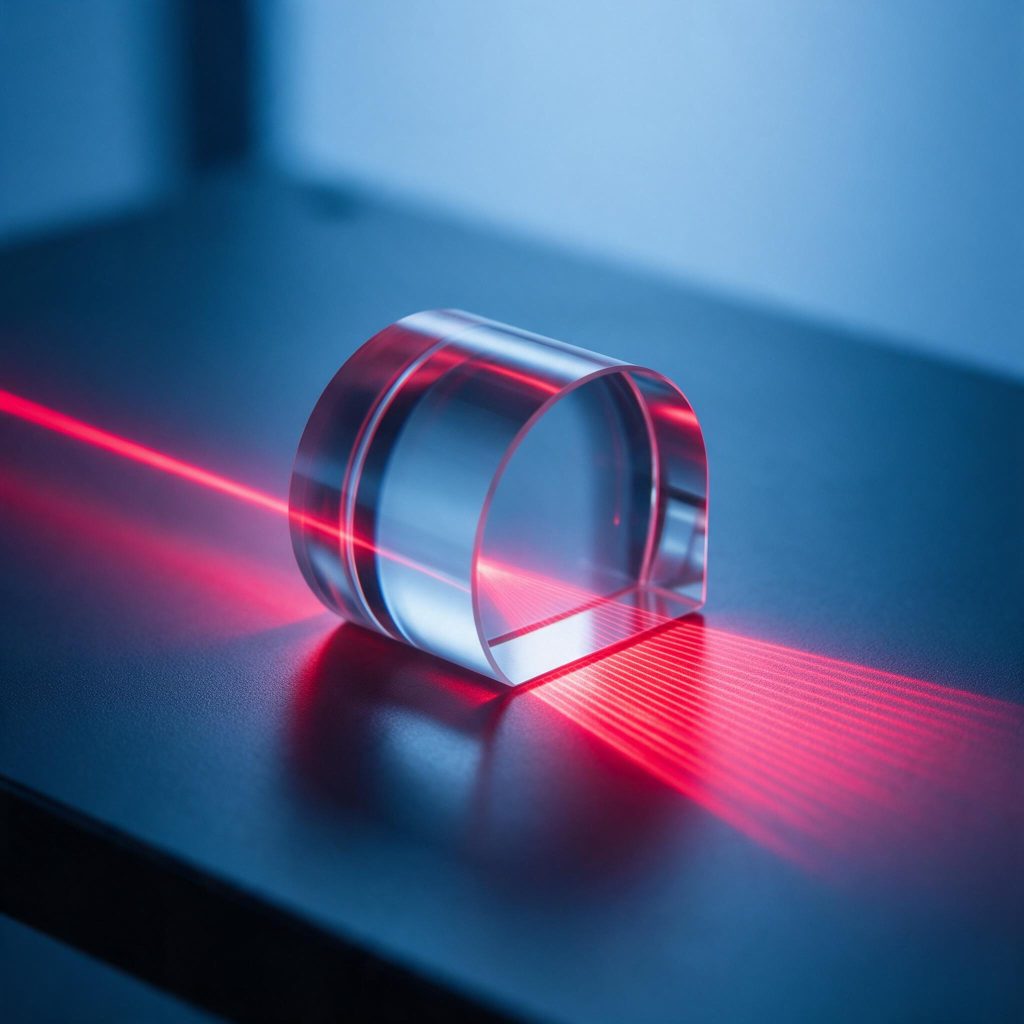
A cylindrical lens has optical power in one axis and little or no power in the perpendicular axis. That one-dimensional behavior makes cylindrical lenses useful for laser line generation, anamorphic beam shaping, astigmatism correction and one-axis focusing in imaging or illumination systems.
Start with the beam or image task
For line generation, describe the input beam diameter and divergence, target working distance, required line length and allowable line width. For anamorphic correction or beam expansion, provide the input beam sizes in both axes and the target aspect ratio. For imaging, identify the sensor, field, conjugates and which axis requires independent focus.
Positive and negative cylindrical lenses
A positive cylindrical lens converges the powered axis and can focus a collimated beam into a line. A negative cylindrical lens expands that axis. A matched positive and negative pair can form an anamorphic telescope, but spacing and orientation are part of the optical design. The focal-length ratio provides a starting magnification; the final result also depends on beam propagation and working distances.
Orientation is a controlled optical parameter
The drawing should identify the cylinder axis, powered meridian and relationship to the mechanical edges or mounting datum. A rotational error changes the direction of the line or couples energy into the wrong axis. Rectangular parts often need an orientation mark, controlled edge relationship or mounted reference surface.
Select focal length from geometry, not a catalog label
Focal length, input beam diameter and propagation distance determine the generated line and waist. A shorter focal length generally creates stronger convergence or divergence but can increase sensitivity to placement and aberration. State whether the quoted focal length is effective focal length, back focal length or another defined value, and include the design wavelength.
Surface form and acylindrical options
A conventional cylindrical surface has a constant radius along the powered axis. An acylindrical surface can add higher-order correction for demanding line quality or compact systems. Surface figure should be specified with a clear datum and test method. For laser applications, wavefront, roughness, coating performance and cleanliness may matter more than a generic cosmetic grade alone.
Material and coating inputs
Common routes include optical glass and fused silica, with other materials reviewed for the wavelength and environment. Define the working band, angle of incidence, polarization, transmission target and laser energy conditions where relevant. An anti-reflection coating must be tied to the actual band and geometry.
Cylindrical lens RFQ checklist
- Application, input beam or imaging geometry and target output
- Positive, negative, plano-convex, plano-concave, bi-cylindrical or acylindrical form
- Focal-length definition, wavelength and powered-axis orientation
- Dimensions, clear aperture, edge relationship and mounting datum
- Surface figure, wavefront, roughness, quality and centration or wedge
- Coating, laser conditions, inspection data, quantity and delivery target
See our custom cylindrical lenses and the broader custom optical component catalog, or send the beam and mechanical requirements to sales@tuolango.com.
Related technical guides
Continue with the next RFQ checklist
Each guide covers one specification step for a different optical or fiber product family.
Specify the positive and negative elements
Use the positive cylindrical lens checklist for line focusing and the negative cylindrical lens checklist for one-axis expansion. For a matched pair, send both prescriptions, spacing and beam targets. Review fused silica material inputs separately when the wavelength or laser load controls the substrate choice.